Every new parent assembles the nursery with near-surgical precision. Firm mattress, checked. No loose blankets, checked. Baby monitor angled for a clear view of the crib, checked. What almost never makes that list is an honest look at the smoke alarm — if one is even mounted in the right location — and whether the device doing sentry duty outside the nursery door is actually capable of protecting an infant who cannot shout for help, cannot open a door, and cannot outrun a smoke-filled hallway on her own. According to the National Fire Protection Association (NFPA), three out of five home fire deaths happen in homes where smoke alarms were absent or failed to operate when the fire started. A nursery is not the room where anyone wants to carry that statistic.
The Problem With "One Alarm Somewhere in the Hallway"
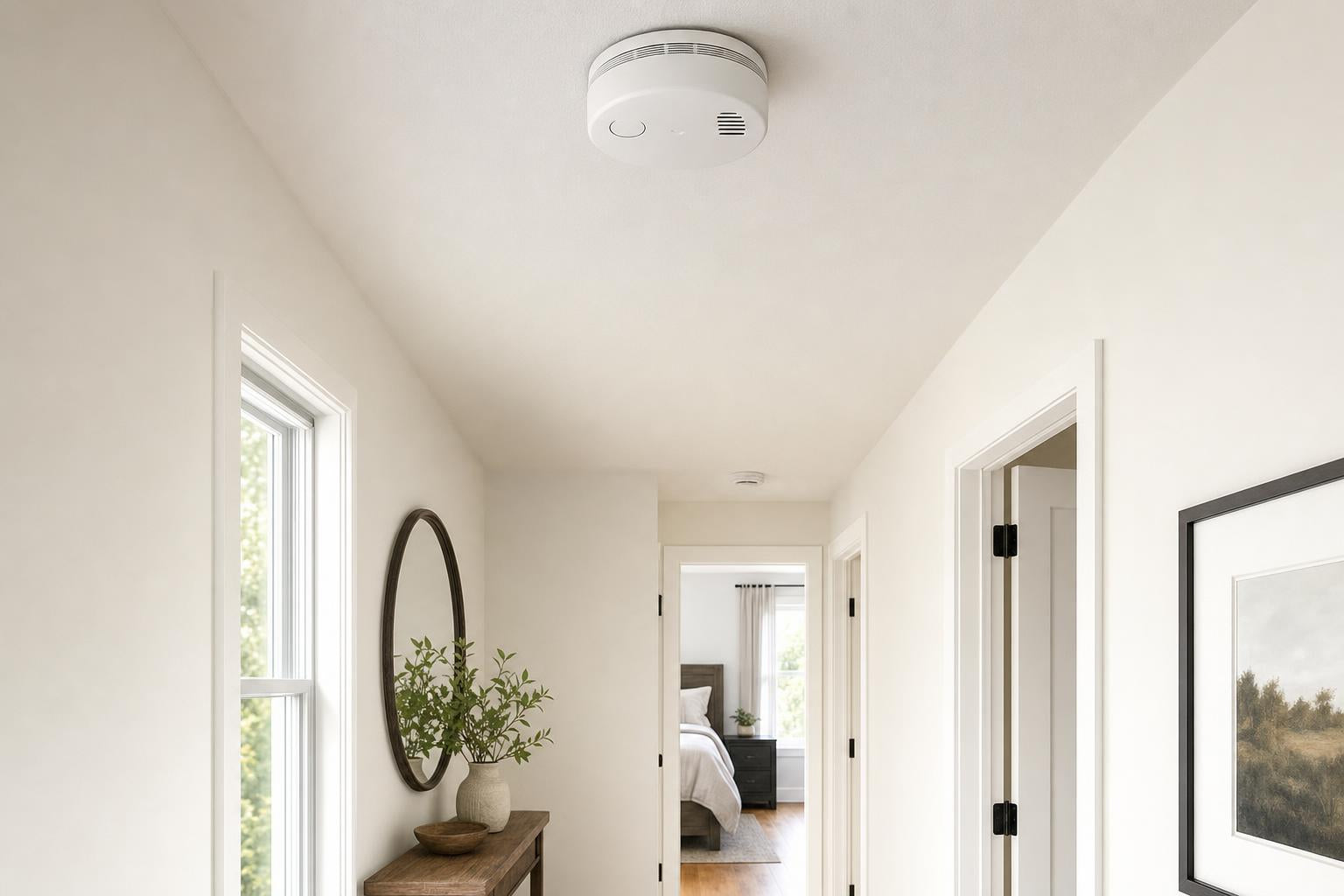
Most rental units and many older homes were built to code minimums: one smoke detector per floor, mounted somewhere in a central hallway. That placement strategy was better than nothing when those codes were written, and it remains better than nothing today. But here is what it misses: smoke rises and spreads, and a detector positioned 20 feet down a hall from a nursery can take significantly longer to trigger than one mounted inside or directly adjacent to the room. The NFPA 72 standard — the national model code governing fire alarm systems — requires a smoke alarm inside every sleeping room, outside each sleeping area, and on every level of the home. "Outside each sleeping area" is not a synonym for "down the hall past two doors." For a nursery, practical fire safety means inside the room or within a few feet of the doorway.
New parents often inherit whatever the previous tenants or the original builder installed. Taking five minutes to verify actual alarm placement against NFPA 72 requirements is not paranoia. It is the kind of basic fire safety due diligence that costs nothing and occasionally saves everything.
Carbon Monoxide Is the Threat a Smoke Detector Cannot See
Here is where even otherwise well-researched nursery setups fall short: a smoke detector, no matter how well placed, cannot detect carbon monoxide. CO is an odorless, colorless gas produced by any fuel-burning appliance — gas furnaces, water heaters, gas stoves, vehicles left running in an attached garage, and even portable generators operated too close to an open window. Infants are physiologically more vulnerable to CO poisoning than adults: their respiratory rate is higher, and their hemoglobin binds CO more aggressively, accelerating the path from exposure to incapacitation.
The U.S. Consumer Product Safety Commission (CPSC) estimates that non-fire-related CO poisoning kills roughly 400 Americans annually and sends approximately 100,000 to emergency rooms each year. Babies and young children are disproportionately represented in the severe-outcome cases. Installing a standalone carbon monoxide alarm in or near the nursery is the minimum defensible position. A smarter solution — one that consolidates the protection profile of the room into a single device — is a combination smoke and CO alarm. These units monitor for both threats simultaneously using separate sensor technologies: photoelectric or ionization sensors handle smoke detection, while electrochemical sensors handle CO. Each hazard triggers a distinct alarm tone. Parents get two critical early-warning systems in one ceiling- or wall-mounted unit, with no second device to install, test, or maintain.
Battery-Operated vs Hardwired in a Nursery Setting
This debate shows up in every home-safety forum, and the answer is more nuanced than either camp usually admits. A hardwired smoke detector draws primary power from the home's electrical system and includes a battery backup for outages. It cannot be silenced indefinitely by pulling a battery, and it is far less likely to fail silently when a sleep-deprived parent forgets a monthly swap. For a nursery in a home already wired for hardwired alarms — generally any home built after the early 1990s — a hardwired smoke detector (ideally wired into the home's interconnected system) is the gold standard.
But rental apartments, older homes, and secondary structures often have no hardwired infrastructure. In those situations, a quality battery-operated smoke alarm is not a compromise — it is the available solution, provided the battery is managed responsibly. That is precisely where the 10-year sealed battery alarm changes the calculation. These units ship with a factory-sealed lithium battery rated to last the full ten-year service life of the alarm. Parents never open a battery compartment, never hear a low-battery chirp at 3 a.m. (which the universe, with characteristic humor, schedules for approximately 2:47 a.m. every time), and never accidentally leave the alarm disarmed after a false alarm triggered by steam from a nursery humidifier. After ten years — when both the alarm and the battery reach end of service — the entire unit gets replaced.
For new parents who are already running a sleep-deficit and managing approximately forty other critical tasks, a 10-year sealed battery alarm in the nursery is one fewer thing to remember and one fewer potential failure mode to worry about. That matters.
Why Interconnected Smoke Alarms Make the Nursery Safer
A smoke detector in the nursery that only sounds in the nursery is a partial solution. If a fire originates in the garage, the basement, or the kitchen — which, per the USFA, accounts for the largest share of residential fire ignitions — and the parents are in the master bedroom with the door closed, they may not hear a single alarm sounding one or two floors away. Interconnected smoke alarms solve this directly: when any alarm in the network triggers, every alarm in the home sounds simultaneously. A kitchen detector triggering at 2 a.m. wakes the adults in the master bedroom and gives them time to reach the nursery before conditions deteriorate.
Hardwired systems achieve interconnection through the building's electrical wiring, which is why licensed electricians always wire a new hardwired detector into the same circuit as the rest of the home's alarms. Many battery-operated models now offer wireless interconnect technology — alarms communicate via radio frequency and trigger each other without any wiring at all. This largely eliminates the "renters can't run new wires" objection. A set of wirelessly interconnected smoke alarms installed throughout an apartment gives renters a protection architecture that approaches what a hardwired system delivers, without touching a single wire or asking the landlord's permission.
The NFPA recommends testing all interconnected smoke alarms monthly and replacing units every ten years regardless of apparent function. Sensors drift over time; a ten-year-old alarm that still sounds when tested may respond more slowly to actual smoke than a new unit. End-of-service dating is not a sales tactic — it is engineering reality.
Where Exactly to Mount the Alarm in a Nursery
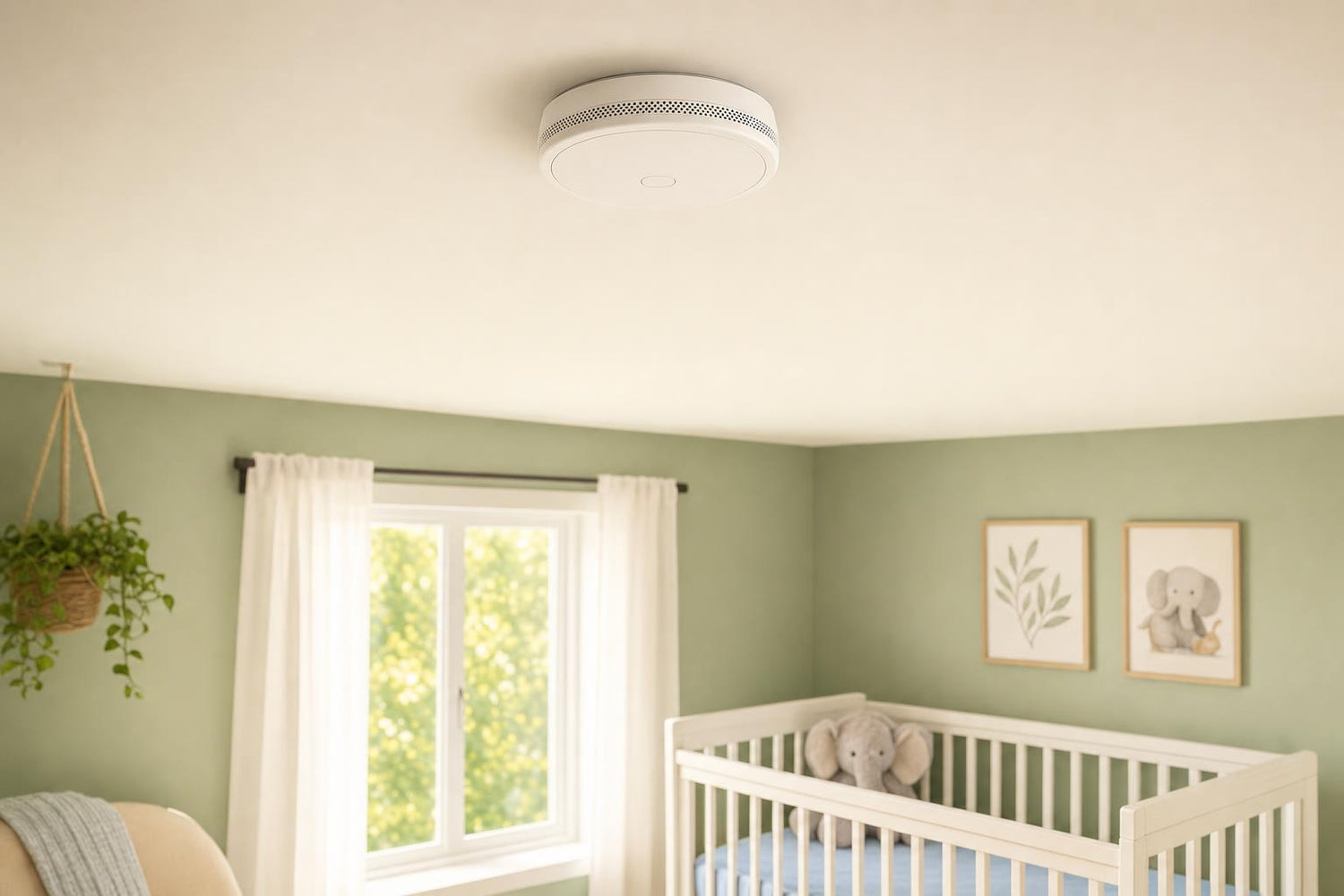
Smoke rises and accumulates near the ceiling first, which is why ceiling-center is the standard recommendation endorsed by both the NFPA and the CPSC. If ceiling installation is not practical — textured rentals, landlord restrictions, structural constraints — the next-best position is high on a wall, with the top of the alarm positioned 4 to 12 inches from the ceiling line. Avoid corners where two walls meet, and particularly the tri-corner where two walls and the ceiling converge. Airflow is weakest in corners, and detection is correspondingly slowest.
Keep alarms away from air supply vents, ceiling fans, and window drafts. Moving air can displace early-stage smoke away from the sensor, delaying detection during the critical first minutes. In nurseries where a portable humidifier runs nightly — standard practice for many parents following pediatric recommendations — mount the alarm on the opposite side of the room from the humidifier. Humidifier steam can trigger nuisance alarms, particularly in ionization-based smoke detectors. Photoelectric smoke detectors are generally less sensitive to steam and cooking aerosols than ionization units, which makes them a pragmatic first choice for rooms where humidity levels vary.
A Combination Smoke and CO Alarm Is the Nursery's Best Single Investment
For parents who want the simplest and most defensible nursery safety setup, a combination smoke and CO alarm mounted on the nursery ceiling handles the two most likely invisible threats with a single device. The case for it is straightforward:
- One device covers two distinct hazards — smoke and carbon monoxide — with separate sensor technologies for each.
- Modern combination alarms use different alarm tones for smoke versus CO events, reducing the chance of confusion during a disoriented 3 a.m. response.
- A 10-year sealed battery combination unit eliminates battery maintenance for the entire decade-long service life of the alarm.
- A wirelessly interconnected combination unit plugs into the home's broader alarm network so the nursery alarm both receives and transmits alerts.
One common objection to combination alarms is that a single unit failure means losing two types of protection simultaneously. The counter to this is regular monthly testing — the 30-second press-and-confirm that the USFA, the NFPA, and every fire safety agency in the country recommends — combined with buying from a manufacturer whose alarms carry verified sensor longevity and a meaningful warranty. The CPSC maintains an active recall database at cpsc.gov; a 30-second search before purchasing any new alarm confirms whether a given model carries any open safety notices.
The One Step Most New Parents Skip Before Move-In Day
Working smoke alarms cut the risk of dying in a reported home fire by roughly half, according to USFA data. "Working" is the operative word. An alarm with an expired battery, a sensor past its ten-year service life, or a location that violates NFPA 72 placement requirements is not working in any meaningful sense, regardless of how it looks mounted on the ceiling.
Before the baby comes home, walk the home with a simple checklist in hand. Verify that every sleeping room — including the nursery — has a smoke detector mounted inside it, not just in the hallway. Confirm that CO detection is present in the nursery and on every level of the home, particularly any floor containing a fuel-burning appliance or an attached garage. Confirm that all alarms are either hardwired into an interconnected circuit or wirelessly interconnected so a single trigger wakes the entire household. Press the test button on every alarm and replace any unit that fails to sound. Replace any alarm that is more than ten years old, regardless of apparent function.
The crib is assembled. The monitor is charged. The outlet covers are installed. These are the visible acts of preparation — the ones that make the nursery look ready. The smoke alarm and the carbon monoxide alarm are the invisible layer underneath all of it, the ones that actually run when everything else has gone wrong. Get those right first, and the rest of the list gets a little easier to finish.