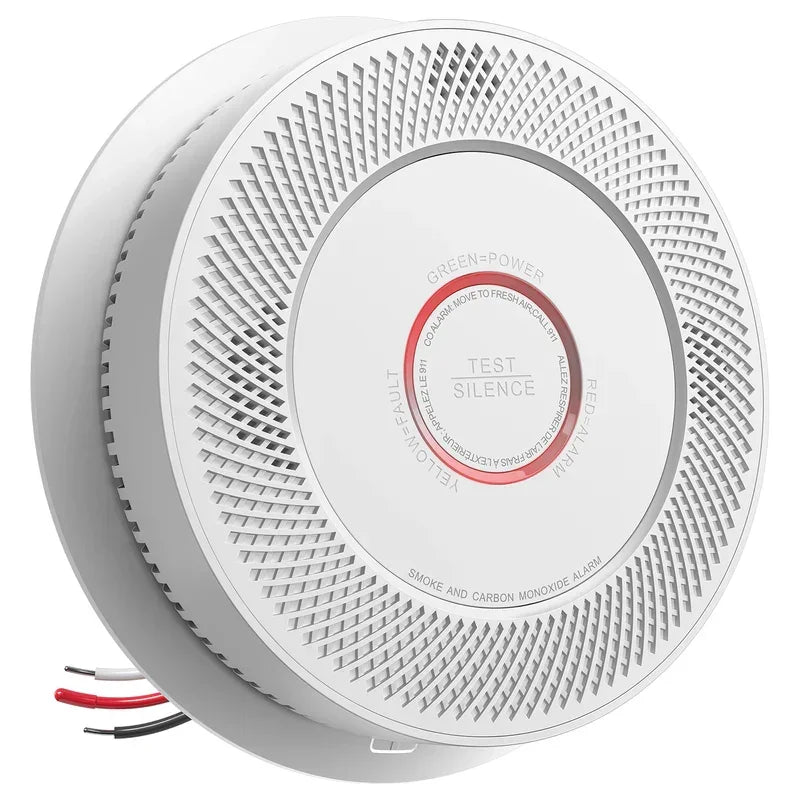
A combination alarm detects smoke and carbon monoxide in one unit. Choose battery power if there is no wiring, 120V hardwired if ceiling boxes already exist, and wireless interconnect if every alarm in the house must sound together.
What is a 2-in-1 combination smoke and CO detector?
A combination smoke and carbon monoxide detector houses two sensors in one unit: a multi-criteria optical chamber that sees smoke, and an electrochemical cell that measures carbon monoxide. One alarm, one bracket, one battery, one place to check every month. Because both threats share a device, a combo alarm is the simplest way to add CO coverage to a room that already needs smoke coverage.
Photoelectric, ionization and electrochemical: which sensor does what
The two sensors are not interchangeable, which is why a dual-sensor alarm carries both.
-
Photoelectric responds to smoke that scatters light — the slow, smoldering fires that start in upholstery, bedding or aged wiring. It is also the sensor type least likely to be triggered by cooking steam, which is why it is the usual choice near a kitchen.
-
Electrochemical is a dedicated CO cell. It does not detect smoke and does not react to cooking.
Some older homes still have ionization alarms, which react quickly to flaming fires but are more easily set off by steam and frying. Every SITERWELL combo model pairs a multi-criteria optical smoke sensor with an electrochemical CO cell.
Standalone vs hardwired vs wireless interconnect
This decision depends on the wiring already in your ceiling.
-
Battery powered / battery operated (standalone). The GS886A-3NCDT runs on a non-replaceable internal lithium battery with a 10-year product life. No wiring, no electrician — the practical choice for rentals, apartments and single rooms.
-
Wireless interconnect. The GS886A-3RFDT links up to 18 alarms over RF, so when one detects smoke or CO, every interconnected unit sounds. Best for multi-floor homes where running cable is not realistic.
-
120V hardwired. The GS886A-3WCAR uses existing 120V wiring with a 2×AA backup; the GS886F-H02 uses 120V with a built-in lithium backup. Both are hard wired to the home circuit, so choose them when the ceiling boxes and interconnect wire are already there.
Weighing a hardwired smoke and carbon monoxide detector against wireless? Keep what the house already has — hardwired is more reliable long-term, wireless is the only option without cable.
How many do I need, and where do they go?
NFPA 72 guidance: install an alarm on every level of the home, one outside each sleeping area, and one inside each bedroom where doors are normally closed. A combo unit counts toward both smoke and CO coverage in that location.
- Keep at least 10 feet (3 m) from a stove or cooktop, and do not install inside a kitchen or bathroom.
- Avoid dead-air pockets in corners, and stay clear of ceiling fans and HVAC vents.
- If the home has an attached garage, furnace room, gas water heater or generator, make sure those levels carry CO coverage.
How long do they last, and what does the chirp mean?
Every SITERWELL combo alarm has a 10-year service life from the date of manufacture. When that period ends, replace the whole unit rather than the battery — a 10-year battery does not extend the life of the sensor.
The TEST/SILENCE button does two things: press it weekly to run a full test, and press it to temporarily silence a nuisance alarm. A single chirp at regular intervals usually means low battery; a different pattern can indicate a sensor fault or end of life. Manuals for every model are on our user manuals page.
Replacing existing wired alarms? See our hardwired interconnected smoke and CO detectors, or read how photoelectric and ionization sensors differ.
Compare SITERWELL combination smoke and CO alarms
All five models in this comparison are tested to UL 217 and UL 2034 and carry a 36-month warranty. Whichever you choose, mount a smoke/CO alarm on every level, one outside each sleeping area and one inside each bedroom. Full specifications are on each product page.