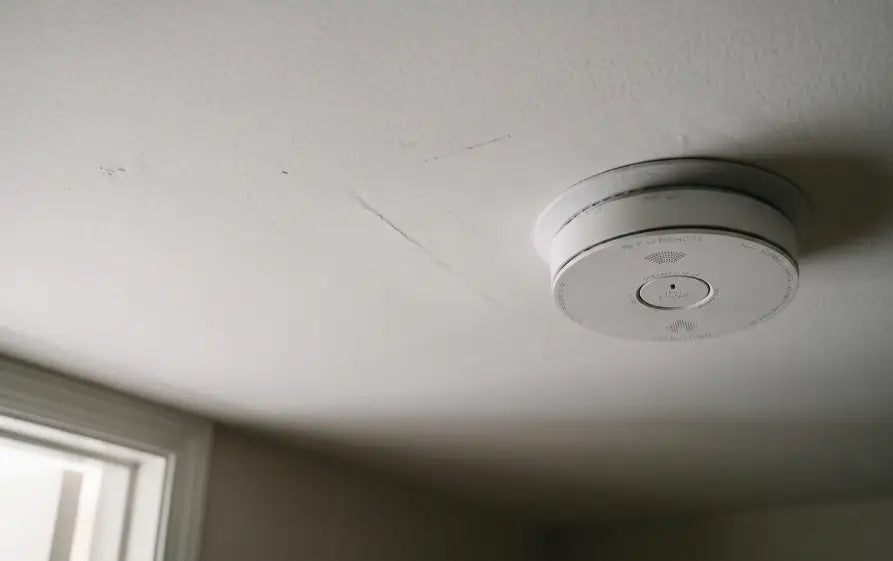
Neither type is better in every room. In its buying guide, the National Fire Protection Association writes that "an ionization smoke alarm is generally more responsive to flaming fires … while a photoelectric smoke alarm is generally more responsive to smoldering fires." The word "generally" is doing real work: it describes which fire each sensor is quicker at, not which fire each one is able to detect.
For the best protection, NFPA recommends both ionization and photoelectric alarms, or combination alarms that contain both. The two sensors are not competing designs of the same thing: they are two different ways of deciding that smoke is present, and each is slower in a different direction.
Photoelectric vs Ionization: The Short Answer
That advice covers a whole home. Where you are choosing between the two for a single alarm, the question narrows — and that is what the rest of this page is about.
Where the risk you are most concerned about is a smoldering fire — upholstery, bedding, overheated wiring — photoelectric sensing is generally the quicker of the two to notice it. Where it is a fast, open flame, ionization is generally quicker. That is a comparison of response time, not a rule for picking a sensor by room.
If you are replacing alarms anyway, NFPA suggests considering a multi-criteria or "intelligent" alarm at that point.
How Many Types of Smoke Detection Are There?
In household alarms there are two types of smoke detection technologies: ionization and photoelectric. Photoelectric sensing is also called optical sensing, and the British spelling of ionization is ionisation — same chamber, different word.
Three other labels get mixed into the same conversation, and they are not interchangeable. A dual-sensor alarm contains both an ionization sensor and a photoelectric sensor. A multi-criteria (or "intelligent") alarm uses multiple sensor inputs, which may include photoelectric, ionization or heat sensing, together with an algorithm, so its exact configuration varies by model. NFPA's own summary is worth keeping: the extra sensors make these alarms better at reducing nuisance alarms, but that "does not necessarily mean that the alarm is able to detect fires sooner."
A combination smoke and carbon monoxide alarm is a different axis entirely. It adds a CO sensor, and by itself says nothing about which smoke sensing method is inside. A heat alarm measures temperature rise rather than smoke, so it is not a third smoke sensing method at all.
How Each Type Detects Smoke
Both alarms are trying to answer the same question — is there smoke in this room — but they measure different physical changes.
Ionization: charged air, not light
An ionization chamber contains a tiny amount of radioactive material — usually a trace of americium-241 — that ionizes the air inside it, creating a small, steady electric current. When combustion particles enter the chamber, they attach to those ions and reduce the current. The alarm reads that drop as smoke.
Because the particles it responds to are small, ionization sensing is quick to react to the fine particles produced by fast, flaming combustion. Fires that start in paper, in a pan of cooking oil or in a flammable liquid are the usual examples, and they can spread quickly. That is the strength NFPA describes when it says ionization alarms are generally more responsive to flaming fires.
Photoelectric: light scattered by smoke
A photoelectric alarm shines a light beam across a chamber that is designed to stay dark. Smoke entering the chamber scatters that light onto a sensor, and the alarm triggers when enough light is scattered.
This method responds to larger particles — the visible smoke produced by smoldering material such as upholstery, bedding or overheated wiring. It is the reason photoelectric alarms are described as generally more responsive to smoldering fires.
Where the Two Types Genuinely Differ
The difference that matters in a real house is not which alarm "wins" a laboratory test. It is which fire type each one is slow to notice.
| What you are comparing | Ionization | Photoelectric |
|---|---|---|
| Particles it responds to | Small combustion particles | Larger, visible smoke particles |
| Generally faster response (per NFPA) | Flaming fires | Smoldering fires |
| Typical slow case | Smoldering upholstery or bedding | Fast, clean-burning flame |
| Common false-alarm trigger | Cooking fumes, steam, aerosols | Dust, steam, some cooking smoke |
Read that table as a warning, not a ranking. Each column contains one row where that alarm is the slower of the two.
"More responsive" is a statement about time, not about capability. NIST makes the same point more plainly: "Both kinds of detectors can detect either slow-burning 'smoldering' fires or fast-burning 'flaming' fires, but each technology has its particular strengths." What the word "generally" concedes is that a single sensor is not equally quick at everything. In a real house the question is how many minutes pass before the alarm sounds, and whether those minutes are enough to get out of a bedroom at night.
That is also why NFPA's recommendation covers both technologies rather than crowning one. A home that covers both response profiles is more robust than one that optimizes for a single fire type. That is a separate question from multi-criteria alarms, which NFPA suggests considering at replacement time for a different reason: fewer nuisance alarms.
Which Type Sets Off Fewer False Alarms
Nuisance alarms are not a minor annoyance. They are the main reason people disable alarms, and a disabled alarm protects nobody.
Ionization sensors are the ones most often blamed for cooking-related false alarms, because they respond to the small particles that cooking produces in quantity. Photoelectric sensors are less prone to that particular trigger but are not immune — steam and dust can still set them off.
NFPA draws a practical conclusion from this. Its first advice is to keep smoke alarms out of the kitchen and bathroom altogether. If the layout of a house forces one near the cooking appliance, the base distance is at least 20 feet (6.1 m); an alarm that is photoelectric, has a silencing button, or is listed for resistance to cooking smoke can sit as close as 10 feet (3 m). And when an alarm does have to sit near those areas, NFPA names the type: "Photoelectric smoke alarms are the best type of alarms to be installed near the kitchen and bathrooms to reduce nuisance alarms."
That is a rare case where the association does prefer one sensor for one specific location — and it prefers photoelectric for nuisance reduction, not for detection speed.
Multi-criteria alarms are marketed partly on the same problem. NFPA notes that new multi-criteria units state "helps reduce cooking nuisance alarms" on the packaging, and suggests considering them when it is time to replace an existing photoelectric or ionization alarm.
If an alarm in your home already sounds every time the oven goes on, the cause may be placement, the sensor, maintenance or the model itself — our guide to stopping nuisance alarms works through the common triggers.
Where Smoke Alarms Belong in a Home
Placement matters more than the sensor choice, and NFPA is specific about it: install smoke alarms inside and outside every bedroom and sleeping area, on every level of the home, and in the basement. A smoke alarm should be on the ceiling or high on a wall.
One distinction to keep straight before the table below. The second column is what NFPA actually asks for; the third is a practical check on the same requirement, not an extra code requirement. Nothing here is a reason to choose a sensor room by room — NFPA's advice is still to cover both technologies across the home.
| Room | What NFPA asks for | What to check there |
|---|---|---|
| Bedrooms | An alarm inside every sleeping room | One alarm inside each sleeping room, not one in the hall serving two bedrooms |
| Hallway or landing outside bedrooms | An alarm outside each separate sleeping area | Interconnect it with the bedroom alarms — a hallway alarm may not reliably wake someone behind a closed door |
| Every level, including basement | At least one alarm per level | The requirement is per level, so the basement counts even if it is only used for storage |
| Living areas | Covered by the level requirement | Usually satisfied by the level alarm; add one only if the layout leaves a distant room uncovered |
| Kitchen | Do not install one in the kitchen. If one has to sit nearby, the base distance is at least 20 feet (6.1 m) from the cooking appliance | An alarm that is photoelectric, has a silencing button, or is listed for cooking-smoke resistance can sit as close as 10 feet (3 m) |
| Bathrooms | Do not install one in the bathroom | Steam triggers both sensing methods, so moving the alarm out is the fix rather than changing type |
One more point from NFPA that is often skipped: it is best to use interconnected alarms, so that when one sounds, they all sound. An alarm in a hallway may not reliably wake someone behind a closed door at the far end of a house.
Whichever sensor you end up with, NFPA also asks that you test every alarm at least once a month, and clean it following the manufacturer's instructions. A sensor type only helps while the alarm is working.
How to Identify the Alarm You Already Have
Both sensing methods are used across the whole price range, and both are sold as ordinary household smoke alarms. A higher price usually buys interconnection, voice alerts, sealed batteries or smart features — not a different sensor.
The two words are also used interchangeably, which is worth clearing up. A smoke detector is the sensing device; a smoke alarm is the complete unit — sensor, circuitry and sounder together. The units sold for homes, with a built-in sounder, are smoke alarms even when the box says detector.
Certification is a separate question from sensor type. The listing mark on the unit is how you confirm a model has been tested to the standard that covers residential smoke alarms — UL 217 in the United States — and neither sensing method is more or less likely to carry one.
The only reliable way to know what you have is to read the packaging or the manual. The manual will name the sensor, and if it does not, the model number will.
If you cannot find the paperwork, our product manual library lists the manuals for every model we make, including the installation and sensor sections.
What We Build, and Why
We should be direct about our own position, because it affects how you read the rest of this page.
Siterwell's current smoke alarm range is photoelectric. On the combination models the manual names the smoke sensor more specifically as Multi-Criteria Optical, listed separately from the electrochemical CO sensor. We do not currently sell an ionization model.
That is a product decision, not a claim that ionization sensing is unsafe or obsolete. Both sensing methods are recognized in the standards that cover residential alarms, and NFPA describes both types as valid choices. Our reasoning is simpler than a safety claim: photoelectric sensing is the method we build around, and this page is written to help you compare the two rather than to rank them.
The photoelectric models are the GS509A, the GS509A-2NCDR, the GS525A and the GS562A; each manual describes the unit as a photoelectric smoke alarm. The multi-criteria optical sensor appears across the GS886 combination range, such as the GS886-H02.
If you are replacing alarms rather than adding them, check what you are replacing before you choose a sensor. A battery-only unit can be swapped for another battery-only unit with no wiring at all. A hardwired unit should be replaced with a hardwired model, and the interconnect has to be compatible — an interconnected system only works when the units on it can talk to each other, so check that in the manual before buying. Where electrical work is needed, NFPA's own advice is to have it done by a qualified electrician and to confirm local code requirements. And if you want one alarm to set off every alarm, that has to exist from the start, either through the existing interconnect wire or through a model built for wireless interconnection.
If your home already has ionization alarms, the sensor type alone does not decide whether they need replacing. NFPA lists four triggers: ten years from the manufacturing date on the back label (seven to ten years for combination smoke and CO alarms), an end-of-life signal, a failed monthly test, or an alarm that has been through a fire. If none of those apply, a working alarm does not have to be swapped just because a different sensor exists — though the ten-year mark is the natural moment to reconsider the type. If you do not know how old yours is, the date code is printed on the back of the unit, and the signs that an alarm is near the end of its life are worth knowing before it starts to fail quietly.
Frequently Asked Questions
Which is better, photoelectric or ionization?
Neither is better in every situation. NFPA states that ionization alarms are generally more responsive to flaming fires and photoelectric alarms are generally more responsive to smoldering fires. That is a statement about response time, and NFPA's recommendation for a home is to cover both rather than pick a winner.
What is the difference between photoelectric and ionization smoke detectors?
They detect smoke using different physical mechanisms. An ionization alarm measures a drop in electric current when small combustion particles enter its chamber. A photoelectric alarm measures light being scattered by larger smoke particles. The first is generally quicker to flame, the second to smoldering.
What does a photoelectric smoke detector detect?
Smoke — specifically the larger, visible particles that smoldering material produces. It responds to smoke from flaming fires as well, usually more slowly than an ionization sensor. The chamber reacts to light being scattered by smoke; it does not measure heat or gas.
Do I need both ionization and photoelectric smoke detectors?
NFPA recommends covering both for the best protection — either both types of alarm, or combination units that contain both. What matters most in practice is an alarm on every level, inside and outside sleeping areas, and interconnecting them, so that one sounding wakes the whole house.
Are ionization smoke detectors being phased out?
We are not aware of any federal rule that removes either sensing method from the market, and NFPA describes both types as valid choices. Requirements are set by local codes, which change on their own cycle, so check your local requirements before installing to satisfy an inspection.
Do photoelectric alarms react faster to all fires?
No. Photoelectric alarms are generally more responsive to smoldering fires, but response varies with the fire and with the specific alarm. For fast, flaming fires, ionization sensing is generally the quicker of the two — which is the case where a photoelectric-only installation is at a disadvantage.
How often should I replace a smoke alarm?
NFPA lists four triggers: ten years from the date of manufacture on the back label (seven to ten years for combination smoke and CO alarms), an end-of-life signal, a failed monthly test, or an alarm that has been through a fire. The sensor type is not one of them.
What is a multi-criteria smoke alarm?
It is an alarm that uses multiple sensor inputs and an algorithm; which inputs it uses depends on the model. That is not the same as a dual-sensor alarm, which contains one ionization and one photoelectric sensor. NFPA notes that new multi-criteria alarms state "helps reduce cooking nuisance alarms" on the packaging, and that the extra sensors do not necessarily mean the alarm detects fires sooner.
Where should smoke alarms go?
Inside and outside every bedroom and sleeping area, on every level of the home, and in the basement, mounted on the ceiling or high on a wall. NFPA advises against putting smoke alarms in the kitchen or bathroom; where one has to sit near the cooking appliance, the base distance is at least 20 feet (6.1 m), or 10 feet (3 m) for a photoelectric alarm, one with a silencing button, or one listed for cooking-smoke resistance. Interconnecting them is best, and they should be tested monthly.
References
- NFPA — Smoke alarms — the two-type classification, the flaming versus smoldering comparison, the placement requirements, the advice to keep alarms out of the kitchen and bathroom, and the monthly test.
- NFPA — What kind of smoke alarm should I buy? — the "generally more responsive" wording quoted at the top of this page, dual-sensor versus multi-criteria, the recommendation to cover both technologies, the 20-foot base distance from a cooking appliance with its 10-foot exception, and the triggers for replacing an alarm.
- NIST — How do smoke detectors work? — that both sensing methods can detect smoldering and flaming fires, with each having particular strengths. NIST's page in turn points to NFPA for the recommendation to use both.
Related Siterwell guides
- Where to install photoelectric and ionization alarms — our room-by-room placement guide.
- Understanding U.S. smoke alarm standards — what the certification actually covers.
About this guide
This guide was written by the Siterwell product team. Siterwell designs and manufactures the smoke alarms described here, and the sensor specifications come from our own manuals. Last reviewed: 22 October 2026.
How it was checked: the general descriptions of how each sensor works, and the comparison between them, were checked against published guidance from NFPA and NIST; where the page quotes either organisation, the sentence appears in quotation marks. Everything else — the placement notes, the buying advice and our own product notes — is our reading of that guidance, not a statement from either of them.
Sensor types were read from the specification table in each manual, not inferred from the product name. The GS509A and GS509A-2NCDR manuals give Model Type: Independent photoelectric smoke alarm; the GS562A gives Multi-station photoelectric smoke alarm; the GS525A states that the unit is a photoelectric smoke alarm. The GS886 manuals list Sensor of Smoke: Multi-Criteria Optical, and the combination models we checked list the CO sensor separately as Sensor of CO: Electrochemical. That is the wording to look for if you want to check a model yourself.
Limitations: this page compares two sensing methods, not specific products. It does not cover heat alarms, and it does not replace the instructions supplied with your alarm or advice from your local fire service.
This is general safety information and does not replace the manual supplied with your alarm. Always follow the instructions for your specific model.