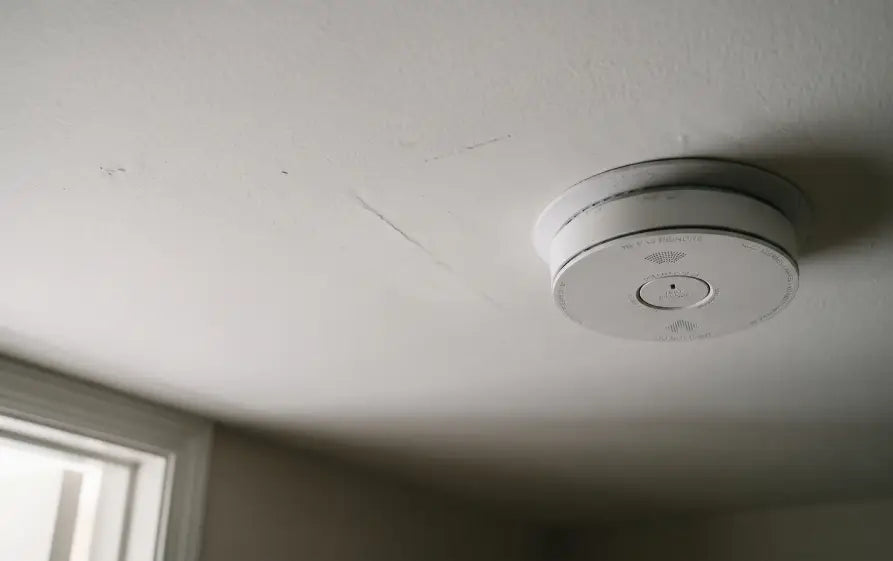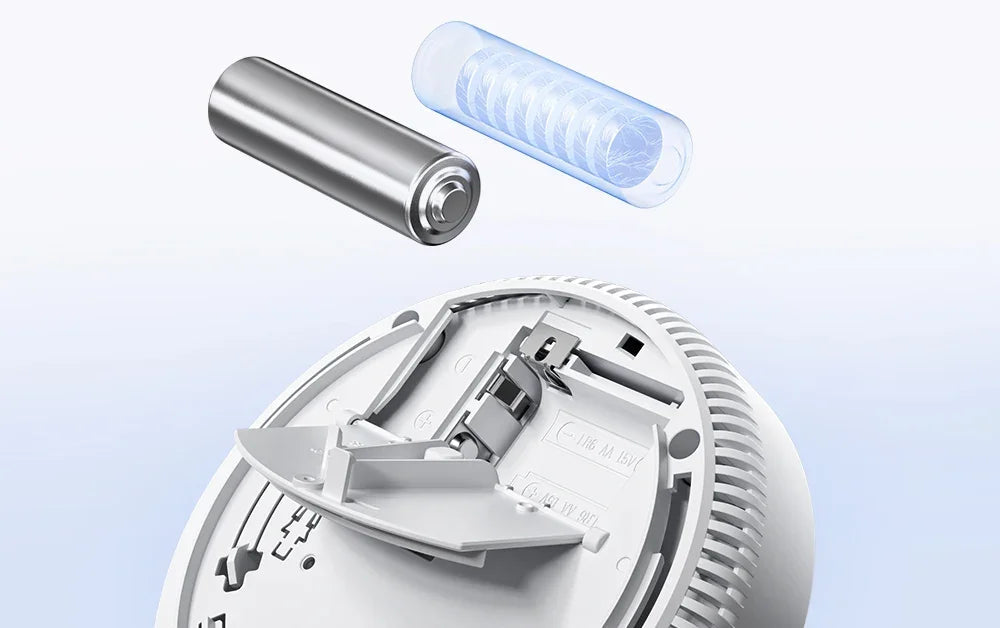
A smoke detector battery can be a 9V cell, a pair of AA cells, a sealed lithium cell that cannot be replaced, or 120V AC mains with a battery backup. Which one your alarm uses decides whether you can change the battery at all: six of the models covered below have no user-serviceable battery, and on those the housing is not meant to be opened. Find your model first, then follow the steps for its power type.
What Batteries Do Smoke Detectors Take?
There is no single answer, and that is exactly why this question causes so much confusion. A smoke detector battery is matched to the alarm's circuit, not to the size of the housing. Four arrangements cover almost every alarm you are likely to find on a residential ceiling, and every Siterwell model in this guide fits one of them.
9V batteries
The traditional standalone smoke detector battery. In our range this is the GS509A and the GS509A-2NCDR, both of which take a single 9V cell in a battery compartment behind a door. The GS509A is specified for a 9V carbon zinc battery. The GS509A-2NCDR is specified for an EVEREADY 1222, a GP1604S or a DURACELL MN1604, and its manual warns against lithium cells in the unit.
Two AA batteries
Common in newer standalone carbon monoxide alarms. The GS828A takes two AA alkaline cells — Energizer E91 or Gold Peak GP 15A — and is rated for about three years of normal operation. Both cells are replaced together; mixing a new cell with an old one shortens the service life the alarm was designed for.
Sealed lithium cells
Found in the sealed 10-year models: GS525A, GS886-H02, GS886-H04, GS886A-3NCDT and GS886A-3RFDT. The cell is built into the alarm and is not replaceable, so the whole unit is replaced at end of life. Note that the GS886F-H02, despite the similar name, is a hardwired model with a sealed backup rather than a battery-only alarm — the 886 family is not uniform.
120V AC with a backup battery
Hardwired and interconnected alarms draw power from the household circuit and keep a battery for outages. The GS562A uses a 9V backup, the GS886A-3WCAR uses two AA cells, and the GS846A uses one CR123A. These alarms are on mains power day to day, so the backup is consumed far more slowly than a battery-only alarm's cell.
So when someone asks whether all smoke detector batteries are the same, the honest answer is no — not in size, not in chemistry, and not in whether the owner is allowed to touch them at all.
How Can You Tell Which Battery Your Alarm Takes?
You do not need to take the alarm off the ceiling to identify its power type. Three checks settle it.
Look for a battery door
A compartment with a door or cover, on the front, side or back of the unit, means the battery is meant to be replaced. A smooth, sealed housing with no door is a 10-year unit. If you cannot find a door, stop there — do not start levering at the case.
Read the label on the back plate
Model number, power supply and battery type are printed there. The model number is the fastest route, because it tells you the exact cell rather than just the size. Two alarms that both say "9V" can still specify different batteries.
Check the manual
If the label is faded, the manual states the power supply in its specification section, and it is the only text that governs what you may install. Our user manual library lists every model we publish documentation for.
Can you use any 9V battery you have at home?
No. A 9V is a shape, not a specification. Our GS509A-2NCDR manual names three acceptable cells and warns against lithium; the GS509A specifies carbon zinc. Fitting a lithium 9V because it lasts longer is a common mistake, and on these models it is explicitly outside the instructions.
The same applies to AA alarms. The GS828A manual recommends Energizer E91 or Gold Peak GP 15A alkaline cells for its rated three-year life. A different chemistry may work briefly and still leave you with a shorter service life than the alarm was designed for.
The GS509A and GS509A-2NCDR are independent photoelectric smoke alarms tested to UL 217, with CAN/ULC S531 for the Canadian market; the GS828A is a carbon monoxide alarm tested to UL 2034. Fitting a cell the manual does not name does not change the standard the alarm was tested to — but it does take the unit outside the battery configuration its instructions describe.
Do Hardwired Smoke Alarms Have Batteries?
Yes — and this is where most people look in the wrong place.
How the two power paths work
A hardwired smoke alarm has two supplies: the 120V circuit and a backup battery. The backup is not there to run the alarm day to day; it is there so the unit still works when the circuit is dead. The GS562A shows how they interact. With AC power lost, the 9V backup allows the alarm to sound for at least four minutes. With a weak battery, protection can last up to seven days. With no battery fitted, the alarm cannot operate at all, even with mains power present. That last point surprises people — a missing backup battery can take a hardwired alarm out of service.
Which backup battery each model takes
Backup batteries differ across the range. The GS562A takes a 9V. The GS886A-3WCAR takes two AA cells. The GS846A takes a single CR123A, and because it sits on mains power a fresh cell is rated to last at least ten years. The GS886F-H02 also runs on 120V AC, but its backup is a sealed internal lithium cell that is not user-replaceable.
Does the backup need replacing every year?
Not on a calendar. Replace the backup when the alarm signals a low battery, and follow the manual's maintenance interval — for our replaceable-backup models that interval is at least once a year. A hardwired alarm with a dead backup and no mains power has no protection at all, which is the argument for replacing it before the chirp starts.
Which Siterwell Models Let You Change the Battery?
This is the table we wish every buyer saw before climbing a ladder. It covers every Siterwell alarm with a published manual, and every row is taken from that model's own manual.
Read the last column first: if your model is listed as No, do not open the case — go straight to the section on sealed models.
| Model | Power | Battery | Can you change it? |
|---|---|---|---|
| GS509A | 9V battery | 9V carbon zinc (EVEREADY 1222 / GP1604S) | Yes |
| GS509A-2NCDR | 9V battery | 9V (EVEREADY 1222 / GP1604S / DURACELL MN1604) | Yes |
| GS828A | Battery | 2 × AA alkaline (Energizer E91 / GP 15A) | Yes |
| GS562A | 120V AC + backup | 9V backup | Backup only |
| GS886A-3WCAR | 120V AC + backup | 2 × AA backup | Backup only |
| GS846A | 120V AC + backup | 1 × CR123A | Backup only |
| GS525A | Sealed | Built-in lithium cell | No |
| GS886-H02 | Sealed | CR17450 internal lithium | No |
| GS886-H04 | Sealed | CR17450 internal lithium | No |
| GS886A-3NCDT | Sealed | CR17450 internal lithium | No |
| GS886A-3RFDT | Sealed | CR17450-2P internal lithium | No |
| GS886F-H02 | 120V AC + sealed backup | CR17450 internal lithium | No |
Three alarms take an owner-replaceable battery. Three more take a replaceable backup. Six have no user-serviceable battery at all — and one of those six is hardwired, which is exactly the case where people reach for a screwdriver.
One more model, the GS886F, went on sale in October 2026. Its store listing describes a hardwired alarm with a two-AA backup, but its manual is not yet in our user manual library, so it has no row here yet — until it does, work from the manual supplied with the unit.
How to Change a 9V or AA Battery
Before you start
Confirm the model from the label, and have the exact cell the manual names before you climb up. On a hardwired alarm, do not disconnect the AC wiring to make the job easier: leave the unit on its bracket where possible and open only the battery door. If the battery can only be reached from the back, switch the power to that circuit off before the unit comes off the bracket — the GS886A-3WCAR and GS886F-H02 manuals carry this as an electrical shock hazard warning, not a suggestion. If you have already established that your model is sealed, stop here and read the sealed-model section instead.
The four steps
- Remove the alarm from its bracket. On the GS509A and GS509A-2NCDR, rotate the unit counterclockwise (to the left) to release it. Do not pull straight down.
- Open the battery compartment. The door or cover sits on the front, side or back of the unit. On hardwired models, leave the unit on its bracket where possible and open only the battery door.
- Swap the cell, watching polarity. Match the positive and negative terminals to the diagram moulded inside the compartment. On a standard 9V cell the smaller circular contact is positive and the wider hexagonal one is negative, which helps when the moulded diagram is hard to read from a ladder. Press the cell flat against the contacts rather than letting it rest loose in the compartment, and check the date printed on the battery you are fitting. On models with a battery door, the door will not close if the cell is in the wrong position.
- Test the alarm. Press and hold the test button for about two seconds on the GS509A and GS509A-2NCDR and confirm a loud, continuous alarm. If you are unsure what a correct test looks like, our guide to testing a smoke alarm walks through each model.
What normal looks like after power-up
One behaviour looks like a fault but is not. On the GS828A, the alarm may sound for several minutes after a new battery is fitted, then stop and settle into normal operation; the manual's advice if it never stops is to contact support rather than keep swapping cells. On the GS509A and GS509A-2NCDR the test button is also the silence button, so a long press during a false alarm is not the same as a test.
Why Is My Smoke Detector Still Beeping After a New Battery?
A smoke detector chirping after a battery replacement is one of the most common support questions, and it usually comes down to one of three things — or to the pattern being something other than a low battery in the first place.
Alarm memory has not been cleared
Hardwired alarms remember the last event. On the GS562A, if the unit has alarmed and nobody has interacted with it for 24 hours, it enters alarm memory mode and the red light flashes twice every eight seconds. Alarm memory is retained for 24 hours, and pressing the test button clears it. Before assuming the new battery failed, clear the memory.
The unit is still settling after power-up
Some models run a short self-check when a battery is inserted. The GS828A manual notes that the alarm may sound for several minutes and then stop. Give it that time before intervening.
The alarm has reached end of life
This is the cause people miss. In the manuals, end of life is a separate state from low battery rather than a power problem, which is why a fresh cell does not stop the signal: on the GS509A-2NCDR and the GS562A that state is three chirps and three red flashes every 40 seconds. On the GS509A-2NCDR, the first end-of-life warning can be reset with the test/silence button during its first 30 days — the unit then stands by for 72 hours before warning again. After 30 days the reset stops working and the alarm must be replaced. Our article on the signs a smoke or CO alarm is aging covers the other end-of-life symptoms.
Which alarm is actually sounding?
In an interconnected system more than one alarm can sound at once, and the noise makes it hard to tell where it started. The GS562A manual gives the tell: during an alarm, the red LED blinks in time with the alarm pattern only on the unit that detected the hazard, while the others sound without that synchronised flash. The manual also notes that more than one unit can be an initiating alarm, so check the whole run before assuming it was the nearest one.
What the light and sound pattern tells you
The pattern is the diagnosis. These are the indicators specified in our manuals, so you can match what you are hearing and seeing to a cause before touching anything.
| What you see and hear | What it means | What to do |
|---|---|---|
| One chirp about every 40 seconds, with the red LED flashing once at the same moment | Low battery (GS509A-2NCDR, GS562A) | Fit a new cell of the type the label names, then test. Do not fit lithium on these models. |
| Three chirps and three red flashes, about every 40 seconds | End of life (GS509A-2NCDR, GS562A) | In the first 30 days, press the test/silence button for a 72-hour standby. After 30 days it cannot be reset — replace the alarm. |
| Red LED flashing twice every eight seconds, no sound | Alarm memory after a past alarm, retained 24 hours (GS562A) | Press the test button to clear it. |
| Three long beeps, a pause, then three long beeps again, repeating | Smoke detected (GS509A-2NCDR, GS562A) | Treat it as real. This is not a battery signal, and silencing it does not make the smoke go away. |
| One chirp about every 40 seconds with the yellow FAULT indicator flashing at the same time | Low battery on the GS828A carbon monoxide alarm — yellow here, not red | Replace both AA cells immediately. The alarm will not detect carbon monoxide once the battery has drained. |
| Two chirps about every 40 seconds with the yellow FAULT indicator flashing | A fault, not a low battery (GS828A) | Replace the batteries. If it continues, the unit has malfunctioned and has no detecting function — replace it and contact support. |
| The alarm sounds for several minutes immediately after a new battery is fitted | Normal power-up self-check (GS828A) | Let it finish. If it never stops, contact support rather than swapping cells again. |
If the chirp is a low battery and it starts at two in the morning, the GS562A manual allows one press of the test button to silence it for about 10 hours. The red LED keeps flashing and the alarm still needs a new cell — the silence buys you a night's sleep, not a fix.
If the sound is coming from a carbon monoxide alarm rather than a smoke alarm, the pattern means something different — we explain the different CO alarm beep patterns separately, because confusing a CO alarm with a low-battery chirp is a safety issue, not an inconvenience.
When the Battery Cannot Be Changed
How to tell it is sealed
If you cannot find a battery compartment, stop. A sealed smoke alarm is designed to be opened only at the factory. Of the models in the table, six have no user-serviceable battery: the GS525A, GS886-H02, GS886-H04, GS886A-3NCDT, GS886A-3RFDT, and the hardwired GS886F-H02. Each manual describes the cell as a non-replaceable internal lithium battery and directs you to replace the alarm at end of life; the GS525A manual states outright that the battery is sealed and is not replaceable. Opening the housing is not a maintenance step in any of them, and there is nothing inside that a new cell can be fitted to.
What to do instead
What to do depends on why you are looking. If the alarm is chirping and the unit is near the end of its service life, replace the whole alarm — the GS525A is one sealed 10-year option in our range, and the smoke detector range shows the current alternatives side by side. If it is a hardwired sealed model, the replacement must match the existing interconnection wiring, so check the hardwired and interconnected range before buying anything.
A sealed battery is not a marketing gimmick. It removes the two most common failure modes in a home: a battery that was never replaced, and a battery that was removed to silence a nuisance alarm and never put back. If that trade-off is what you are looking for, the sealed models are the one to choose; if you prefer to keep a spare 9V in a drawer and swap it yourself, the GS509A and GS509A-2NCDR remain the simpler choice. Both approaches are legitimate — they simply suit different households.
Frequently Asked Questions
Are all smoke detector batteries the same?
No. Residential smoke alarms use 9V cells, pairs of AA cells, sealed lithium cells, or mains power with a backup battery. The correct cell is defined by the model, not by the size of the battery compartment, and some models have no replaceable battery at all.
Can you use any 9V battery in a smoke alarm?
No. Our GS509A-2NCDR manual specifies EVEREADY 1222, GP1604S or DURACELL MN1604, and warns against lithium cells; the GS509A specifies 9V carbon zinc. A 9V lithium may fit and may last longer, but it is outside the instructions for these models.
Can I replace the battery in a 10-year smoke alarm?
Not in ours. The GS525A, GS886-H02, GS886-H04, GS886A-3NCDT and GS886A-3RFDT have their lithium cell built into the alarm, and the GS886F-H02 keeps a sealed cell inside a hardwired housing. When the cell or the sensor reaches end of life, the whole alarm is replaced rather than opened.
Do hardwired smoke alarms need a new battery every year?
Replace the backup when the alarm signals low battery, and follow the manual's interval — for our replaceable-backup models that is at least once a year. A missing backup battery can leave a hardwired alarm unable to operate during an outage.
Why is my smoke detector still beeping after a new battery?
Three common reasons: alarm memory has not been cleared (press the test button on hardwired models), the unit is still settling after power-up, or the alarm has reached end of life and is signalling the sensor rather than the battery. On the GS828A, two chirps every 40 seconds with a yellow light is a fault, not a low battery.
How do I know when to replace the whole alarm instead of the battery?
When the alarm is at or near ten years from its manufacture date, when the end-of-life signal cannot be reset, or when the model has no replaceable battery. Check the date printed on the back of the unit.
How often should I replace smoke detector batteries?
For replaceable models, at least once a year and whenever the low-battery signal sounds — the GS828A manual suggests doing it when you change your clocks for daylight saving time. Sealed models never need a battery change; the alarm is replaced instead.
About this guide
Last reviewed: 26 October 2026. Battery types, power supplies, indicator patterns and reset behaviour in this guide are taken from the current Siterwell product manuals for each model named, and the model list was checked against the live store catalogue on 26 October 2026; statements about 9V terminal geometry are general battery facts rather than model-specific instructions; specifications can change between production runs, so your own manual and the label on the back of the alarm take precedence. For general guidance on alarm age and replacement, see the NFPA smoke alarm information page.