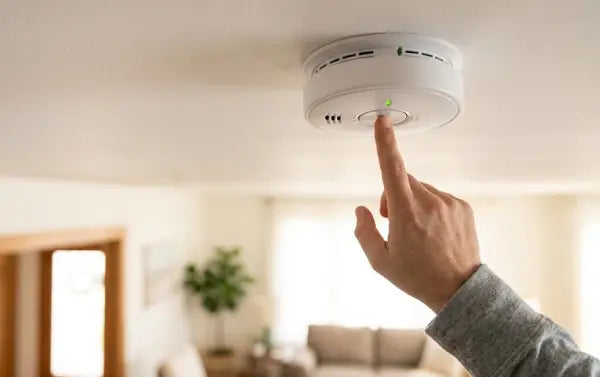
A smoke alarm only helps if it can sound when you need it. Pressing the test button takes a few seconds; allow a little more time if you are checking several alarms or making sure interconnected units sound together. Below is how to check yours.

How to test a smoke alarm in 4 steps:
- Tell everyone in your home you're about to test the alarm, so the loud sound doesn't startle anyone.
- Press and hold the Test button until the alarm sounds. Hold it for a few seconds. On many Siterwell models this is about 1 to 3 seconds (the exact time varies by model), and always follow the hold time in your model's manual.
- Listen for a loud, clear alarm. If your alarms are interconnected, check that every connected unit also sounds.
- Act on the result. If an alarm is silent, weak, damaged, or at or past the service life shown on its label, troubleshoot it using the manual and replace it if it still fails.
Test every smoke alarm at least once a month. This is the minimum recommended by the U.S. Fire Administration and the NFPA. Some Siterwell model manuals may recommend more frequent testing, so always follow the testing instructions in your specific model's manual.
Never use a candle, match, lighter, or any open flame to test a smoke alarm. Use only the built-in test button and follow the manufacturer's instructions. An open flame can damage the alarm or start a fire.
Do not test a smoke alarm with:
- A match, lighter, candle, or any open flame
- Any smoke-producing material, household spray, or aerosol, unless your model's manual specifically approves that method
- Paint, tape, or objects placed over the alarm
Use the built-in test button for routine testing, and follow your product manual for any additional manufacturer-approved maintenance procedure.
What the smoke alarm test button actually checks
For routine home testing, use the built-in Test (or TEST/SILENCE) button exactly as directed in your alarm's manual. It's the standard, safe way to check that your alarm is working.
What a button test confirms: the alarm's power source, electronics, and horn are working, and the unit can produce its warning sound. Applicable Siterwell models are rated at approximately 85 dB at the specified test distance. Check your model's label and manual for the exact specification.
What the button test does not replace: it does not fully verify real-world smoke-sensor performance, and it is not a substitute for regular cleaning, timely replacement, or any model-specific maintenance in your manual. A home test-button check is also different from professional sensitivity testing or inspection procedures used in commercial systems.
A loud test tone is reassuring, but it does not reset the clock on an old alarm. If you can't remember when it was installed, take it down long enough to find the manufacture date on the back before you move on.
Common smoke alarm sounds and what they may mean
Not every beep means the same thing, and the pattern is what matters. A repeating alarm calls for immediate attention, while an occasional chirp usually points to a battery, fault, or end-of-life issue.
- Smoke/fire: many U.S. residential alarms use a repeating three-beep pattern (three beeps, pause, three beeps), sometimes with a "Fire!" voice alert.
- Carbon monoxide (CO): many use a repeating four-beep pattern (four beeps, pause, four beeps), sometimes with a "Carbon Monoxide" voice alert.
- Low-battery or fault: typically a single short chirp about once a minute. This is not an emergency alarm, but it needs attention.
Voice alerts, beep timing, and indicator behavior vary by model, so always use your alarm's manual as the final reference. A status light may show that an alarm has power or is in standby, but its color, flash pattern, and meaning vary by model. A status light does not prove the alarm is within its service life or that it will pass a functional test. For Siterwell alarms, check your model-specific manual for the correct LED pattern and meaning.
A single chirp about once a minute commonly signals a low battery, a fault, or an end-of-life condition, rather than the repeating emergency alarm pattern. If you see or smell smoke, feel unsafe, or hear a repeating fire alarm pattern, leave the home and call 911. For a persistent chirp, see our guide on how to stop nuisance chirps and false alarms.
How to test standalone, hardwired, and wireless smoke alarms
The test-button step is the same for every alarm, but what you do afterward depends on how yours is powered and connected:
- Standalone battery alarms (single-room, easy install): test with the button. If it uses a sealed, non-replaceable battery (commonly rated for 10 years), you can't change the battery. When it reaches end of life or chirps for low battery, replace the entire alarm. If it uses a replaceable battery, replace the battery when it chirps, then test again. For example, the Siterwell GS525A 10-year sealed-battery smoke alarm uses a built-in lithium cell, so you replace the whole unit at end of life.
- Hardwired alarms with battery backup: these use household AC power and switch to a backup battery during an outage. Test the front button first. If your model has a replaceable backup battery, use the battery type printed inside the battery compartment, close the unit fully, and test it again. The Siterwell GS562A hardwired interconnected smoke alarm is one example of a hardwired model with backup power.
- Wireless interconnected alarms (whole-home coverage without wiring): test using the steps in the next section, where you'll verify that linked units respond together.
Tip: A hardwired alarm can have power and a lit status light yet still be expired. Power is not the same as being within its service life.
How to test wireless interconnected smoke alarms
Interconnected alarms are designed so that when one detects danger, they all sound. That is what alerts someone sleeping on another floor. Testing them takes one extra step:
- Press and hold the test button on one alarm until it sounds.
- Within a few seconds, the other connected alarms should also sound. That confirms the interconnect signal is working.
- Important: when the other alarms sound, that confirms the interconnect signal and their audible-alert response worked. It does not confirm that every alarm's own smoke-sensing function is working, so test each unit individually as directed in its manual.
If one unit doesn't join the group alarm, re-check its connection or link setup per the manual, and replace it if it still fails. Compatible Siterwell wireless interconnected alarms (for example, the GS886A-3RFDT and GS886-3NCDT) can be linked to help provide a whole-home warning system, with different models supporting up to 12 or 18 linked units. Check each product page and manual to confirm the exact limit and compatibility before pairing models, since interconnection works only between compatible units.
Smoke alarm failed the test? Here's what to do
Use this quick decision guide:
| What happened | What it usually means | What to do |
|---|---|---|
| No sound at all | Dead/loose battery, no power, or a failed unit | Check the battery and power; if it still won't sound, replace the alarm |
| Weak or distorted sound | Low battery or an aging/faulty unit | Replace the battery; if the sound is still weak, replace the alarm |
| Chirps after you changed the battery | Wrong/loose battery, or end-of-life warning | Reseat a fresh battery. If it keeps chirping, the unit has likely reached end of life, so replace it |
| Only one interconnected alarm sounds | Interconnect/link issue | Re-check the link setup per the manual; replace the unit that won't join |
| Alarm is at or past the service life on its label | Sensing components may be beyond their rated life | Replace it, even if it still beeps during a test |
A smoke alarm that stays silent during a test means that area may not warn you in a fire. If yours won't sound after you've checked the power, battery, and manual, replace it instead of leaving that area unprotected. A Siterwell 10-year sealed-battery smoke alarm gives you a fresh unit with a long-life sealed power source and no annual battery changes.
Renting? If a required smoke alarm is missing, damaged, expired, or fails its test, notify your landlord or property manager promptly. Never disable or remove an alarm to stop a nuisance chirp.
When to replace a smoke alarm
A test shows the alarm works right now. The date on the back shows whether it's still rated for use.
- Find the manufacture date. Look on the back of the alarm for a "manufactured" or "date of manufacture" label. This is the date that matters, not the day you bought or installed it.
- Replace at end of service life. Replace a smoke alarm at the end of the service life shown on its label or manual. For residential smoke alarms this is commonly 10 years from the manufacture date (some CO and combination alarms sooner, so check the label). Replace sooner if it fails a test or shows an end-of-life warning. The U.S. Fire Administration and NFPA support the 10-year guideline for smoke alarms.
If you're replacing one aging alarm, it's often worth checking the rest, since alarms installed at the same time usually expire around the same time.
How often should you test smoke alarms?
Test every smoke and CO alarm at least once a month. This is the minimum recommended by the U.S. Fire Administration and NFPA. Some Siterwell model manuals may recommend more frequent testing, so follow the instructions for your specific model.
A few habits that help:
- Pick an easy-to-remember day (the first of the month, or when you pay a recurring bill).
- Gently vacuum around the alarm's exterior vents with a soft brush attachment, following the cleaning instructions in your model's manual. Do not paint, cover, spray, or insert objects into the alarm.
- Test again any time you change a battery, return from a long trip, or after renovation dust.
Can everyone hear it? Whole-home audibility
Do not stop after the hallway alarm sounds. Ask someone to stand in each bedroom with the door closed while you test. If they can't clearly hear the alert, your current setup may not give enough warning where people sleep. Closed doors, multiple floors, basements, and large layouts can all muffle a single alarm.
If a sleeping area can't clearly hear the alarm, that's a coverage gap. Wireless interconnected smoke alarms help here: when one senses danger, they all sound together. Compatible Siterwell interconnected alarm packs can help extend audible warning coverage across the sleeping areas and levels of your home. Choose the number and type of alarms based on your layout and your model's instructions.
If someone in your home is deaf or hard of hearing, consider alert devices designed for hearing loss, such as compatible strobe lights or bed-shaker alerts, and follow local fire-safety guidance.
Keep a simple smoke alarm test record
Writing down each test makes it easy to spot an alarm that repeatedly chirps, fails to interconnect, or is approaching the end of its rated life. Here is a filled-in sample log you can copy to track every alarm in your home. Note the location, test date, result, and the manufacture date on the back of each unit.
| Location | Test date | Result | Manufacture date | Replace by |
|---|---|---|---|---|
| Main hallway | Oct 2026 | Pass | Mar 2024 | Mar 2034 |
| Primary bedroom | Oct 2026 | Pass | Jan 2022 | Jan 2032 |
| Upstairs bedroom | Oct 2026 | Replaced (was silent) | Sep 2015 | Replaced Oct 2026 |
| Basement | Oct 2026 | Pass | Jun 2023 | Jun 2033 |
Smoke alarm testing FAQs
How do I know if my smoke alarm is working?
Press and hold the test button until the alarm sounds loudly and clearly. A full-volume alert means the battery, electronics, and horn are working. If the sound is weak, delayed, or absent, replace the battery and test again. If it still fails, replace the alarm.
How often should you test a smoke alarm?
Test every smoke alarm at least once a month. Follow your alarm's manual if it specifies a more frequent schedule.
How long should I hold the test button on a smoke alarm?
Hold it until the alarm sounds, usually a few seconds. On many Siterwell models this is about 1 to 3 seconds, but always follow your specific manual for the exact duration.
What should I do if my smoke alarm doesn't sound when I test it?
First check the battery and power connection, then test again. If it still won't sound, or the sound is weak, replace the unit rather than leave the area unprotected. Also replace an alarm that has reached the end of the service life shown on its label or manual.
Can I test a smoke alarm with a candle, match, or lighter?
No. Never use an open flame to test a smoke alarm, because it can damage the unit or cause a fire. The built-in test button is the recommended method, so follow your manufacturer's instructions.
Keep your family protected
Testing your smoke alarms is one of the simplest home-safety checks you can do. Press the button, listen for the alert, confirm every room can hear it, and replace any alarm that fails or is past the service life on its label.
Replace a failed or expired alarm
Explore Siterwell's 10-year sealed-battery smoke alarms for a fresh alarm with a long-life sealed power source and no annual battery changes.
Upgrade whole-home warning coverage
Explore wireless interconnected smoke & CO alarms so compatible alarms can sound together throughout your home.
Reviewed for product accuracy
This guide was reviewed against current Siterwell model manuals and product specifications available at the time of review. Product features, test-button timing, battery type, and interconnect compatibility vary by model. Use the instructions supplied with your alarm as the final reference.
Last reviewed: September 2026
Safety references
- U.S. Fire Administration: Smoke Alarms
- NFPA: Smoke Alarms
- Your specific Siterwell product manual