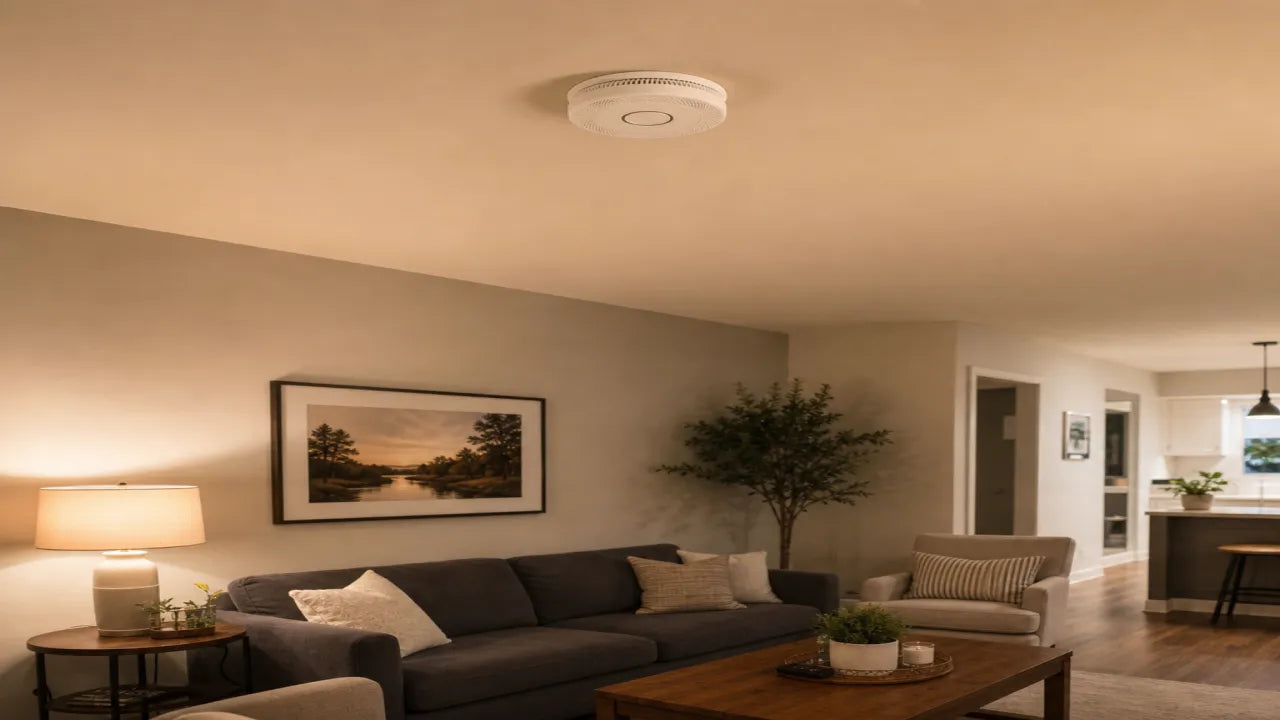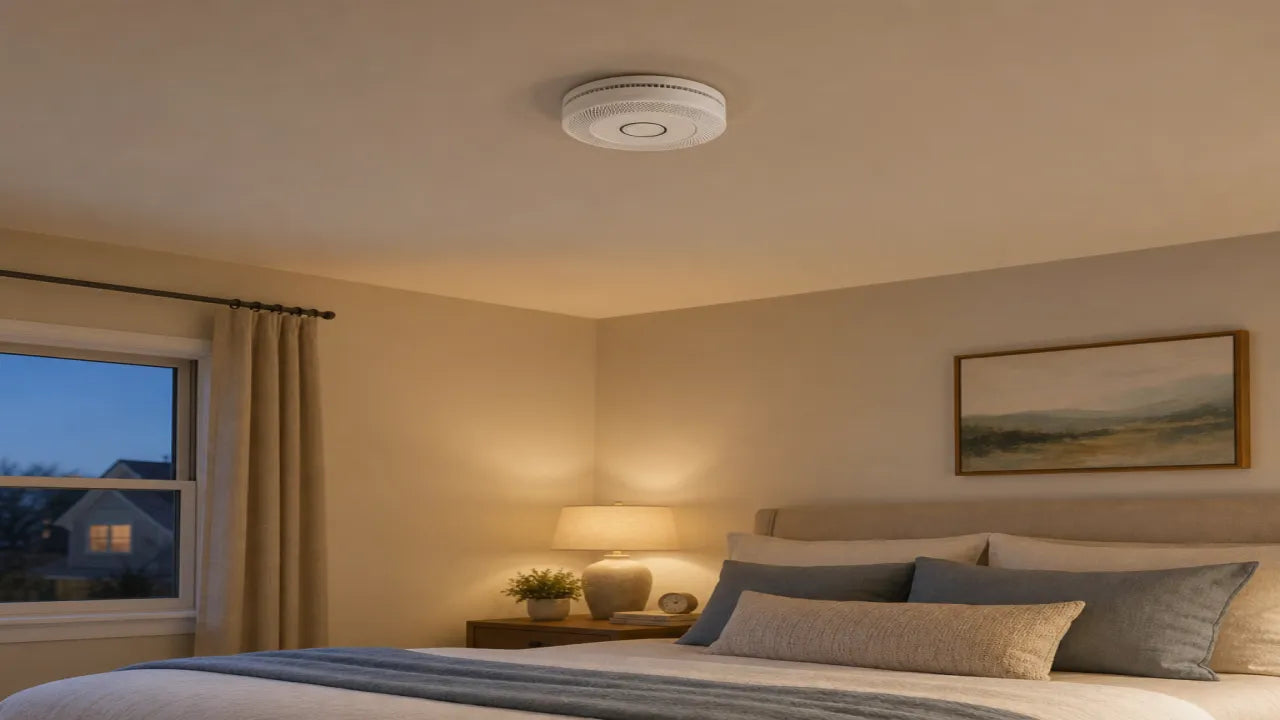
The Fire Risk No One Talks About When a Parent Lives Alone
Ask most adult children whether their elderly parent has a smoke alarm, and the answer is yes. Ask whether that smoke alarm will actually wake the parent up in time during a nighttime fire — and the conversation gets uncomfortable fast. A device that meets every UL certification and sits six inches from the right spot on the ceiling can still fail an older adult in the moments that matter most. The failure is not in the hardware. It is in the mismatch between what a standard smoke alarm was designed for and the specific vulnerabilities that come with aging.
According to the NFPA, adults aged 65 and older face a home fire death rate roughly twice that of the general U.S. population. The gap widens further for adults over 75. Those numbers reflect a combination of factors — reduced mobility, age-related hearing loss, the sedating effects of common medications, and the statistical reality that many older adults live alone, with no one nearby to respond when an alarm sounds. Standard smoke alarms address exactly none of these variables. They emit a loud high-frequency tone and assume the occupant will hear it, process it, and move. For younger, fully able-bodied adults, that assumption is generally correct. For a significant share of the 57 million Americans aged 65 and older, it is not.
Hearing Loss and the Standard Alarm's Blind Spot
Approximately one in three adults between the ages of 65 and 74 has some degree of hearing loss, and that figure rises to nearly half of adults over 75, according to the National Institute on Deafness and Other Communication Disorders (NIDCD). High-frequency hearing loss — the most common age-related pattern — disproportionately affects the 3,100 Hz range that traditional ionization smoke alarms use for their primary alert tone.
UL 217 requires a minimum output of 85 decibels at 10 feet for residential smoke alarms. For a person with normal hearing, that is more than sufficient to trigger waking. For someone with moderate high-frequency hearing loss, especially asleep in a bedroom with the door closed, that same 85-decibel signal at a frequency the ear no longer processes efficiently may simply not register before dangerous smoke concentrations develop.
Research published in the journal Pediatrics (and subsequently cited in home fire safety literature) found that low-frequency alarms — particularly those using a 520 Hz square wave tone — wake sleeping subjects, including older adults, more reliably than the standard high-frequency signal. Some combination smoke and CO alarms now incorporate selectable or dual-frequency alert tones for precisely this reason. When selecting a battery-operated smoke alarm or a hardwired smoke detector for an elderly parent's home, checking the alert frequency specification is not a trivial detail.
Why Voice Alarms Outperform Tone-Only in Older Households
Beyond frequency, there is the matter of comprehension under stress. A standard alarm emits a pattern of beeps. Waking from deep sleep to a pattern of beeps requires a cognitive processing step — mapping that sound to the meaning "fire" — that takes measurable time and is impaired by sleep inertia, hearing loss, and any number of medications commonly prescribed to older adults (sleep aids, antihistamines, antidepressants with sedating effects).
Voice alarm technology addresses this directly. Rather than a tone, these alarms emit a spoken message — "Fire. Fire. There is smoke in the hallway." The specificity is important: research has shown that voice alarms wake sleeping adults more reliably than tone-only alarms, and they convey location information that helps occupants make faster escape decisions. For an elderly person waking disoriented in the night, "Fire — get out" is a faster cognitive path to action than three beeps repeated.
Not every smoke alarm on the market offers a voice alert mode. For households with older adults, this feature narrows the list considerably and is worth the additional cost.
Interconnected Alarms: The Coverage Older Adults' Homes Often Lack
Older homes — where a disproportionate share of elderly Americans live, having owned their residences for decades — frequently have smoke alarm coverage that was installed piecemeal over the years. A single ionization alarm in the hallway. A carbon monoxide alarm plugged into a kitchen outlet. A battery-operated smoke alarm in the master bedroom added after a scare with the toaster.
This ad hoc approach creates gaps that interconnected smoke alarms are specifically designed to close. In an interconnected smoke alarm system — either wired to a shared circuit or linked wirelessly — triggering any single unit causes every alarm in the network to sound simultaneously. In a two-story or multi-room home where an older adult may be at the back of the house with doors closed, a fire starting in the kitchen or basement can be halfway to cut off escape routes before a standalone alarm in an adjacent room reaches them. An interconnected system removes that delay.
For homes without existing hardwired alarm circuits — common in housing stock built before the 1990s — wireless interconnected smoke alarms offer the same whole-home alert capability without running new wiring. The installation is no more complex than replacing a standard battery-operated smoke alarm. For an adult child managing a parent's home from a distance, a wireless interconnected system is often the most practical upgrade available.
CO Alarms Are Not Optional for Older Adults
Carbon monoxide deserves specific attention in any discussion of fire safety for elderly residents. CO poisoning symptoms — headache, dizziness, confusion, and nausea — are easily mistaken for influenza or the side effects of medications. In a younger, otherwise healthy adult, rising CO exposure is more likely to trigger a response before incapacitation occurs. In older adults, particularly those with cardiovascular or respiratory conditions, the physiological tolerance is narrower and the early warning signs are more easily attributed to something else entirely.
The U.S. Consumer Product Safety Commission (CPSC) data consistently shows that adults over 65 are among the most vulnerable demographic groups in unintentional non-fire carbon monoxide incidents. A combination smoke and CO alarm placed in the bedroom and on each occupied level of the home is not optional for households with older residents — it is the baseline. The 400-plus annual CO fatalities tracked by the CPSC represent the severe end of a much larger population of exposures that cause cognitive impairment, cardiac stress, and emergency-department visits without ever rising to the threshold that a sleeping person would recognize on their own.
The 10-Year Sealed Battery Alarm Is Especially Important Here
Battery maintenance is a genuine reliability problem in elderly households. An older adult who lives alone, has limited mobility, or who relies on adult children for periodic home maintenance may not reliably replace the batteries in smoke detectors when the low-battery chirp begins. The chirp is easy to ignore or attribute to something else. The battery often stays dead for weeks or months.
The 10-year sealed battery alarm removes this failure mode from the equation. These devices contain a factory-installed lithium cell rated to power the alarm for the full ten-year service life of the unit, with no user-replaceable battery required. For elderly residents and the family members who worry about them, this is not a minor convenience feature — it is a direct fix for one of the most documented causes of smoke alarm failure in residential fires. When the unit reaches the end of its service life, the entire device is replaced rather than just the battery, which also keeps the sensing chamber on the same replacement schedule.
A Practical Audit Guide for Adult Children
The following checklist is designed for an adult child conducting — or arranging — a home safety audit for an elderly parent's residence:
- Locate every smoke alarm and CO detector in the home. Pull each off the ceiling or wall and check the manufacture date label on the back. Replace any unit 10 years old or older without exception.
- Test every alarm that remains within its service life. A faint or failed test response is grounds for immediate replacement regardless of age.
- Verify placement: at least one alarm on every level, one inside every bedroom, and one outside each sleeping area. For CO, one on each level and in any room with a fuel-burning appliance or attached garage access.
- Check the alert frequency specification of each alarm. If the parent has known hearing loss, prioritize alarms with low-frequency (520 Hz) or voice-alert capabilities.
- Evaluate whether existing alarms are interconnected. If not, assess whether a wireless interconnected smoke alarm system is feasible given the home's layout.
- Replace standalone smoke-only alarms near bedrooms with combination smoke and CO alarms if the home uses any gas appliances or has an attached garage.
- Where possible, choose 10-year sealed battery models to eliminate the battery maintenance variable.
- Document the installation date of all new alarms. Set a calendar reminder for the nine-year mark as a replacement planning trigger.
- Brief the older resident on what to do when an alarm sounds — not just "get out," but which exit is safest from which room, where to meet outside, and who to call.
The audit itself takes an hour. The protection it provides lasts a decade. For the 57 million older Americans living in homes where a smoke alarm's design assumptions were built around a different occupant, that hour is among the more useful ones an adult child can spend.
The Gap Between Having an Alarm and Being Protected by One
Smoke alarm ownership rates in the United States are high — NFPA data puts working alarm presence at approximately 96 percent of American homes. The fire death rate for older adults, meanwhile, continues to run at roughly double the national average. Those two facts exist simultaneously because the coverage metric and the protection metric are not the same thing.
A standard smoke alarm installed in 1998, emitting a high-frequency tone that a hard-of-hearing 78-year-old cannot reliably detect through a closed bedroom door, counts as "present and working" in every aggregate statistic. It does not count, in any practical sense, as protection. Closing that gap for the older adults in any family's orbit starts with understanding what a smoke detector can and cannot do — and choosing equipment that is actually designed for the people it is meant to protect.