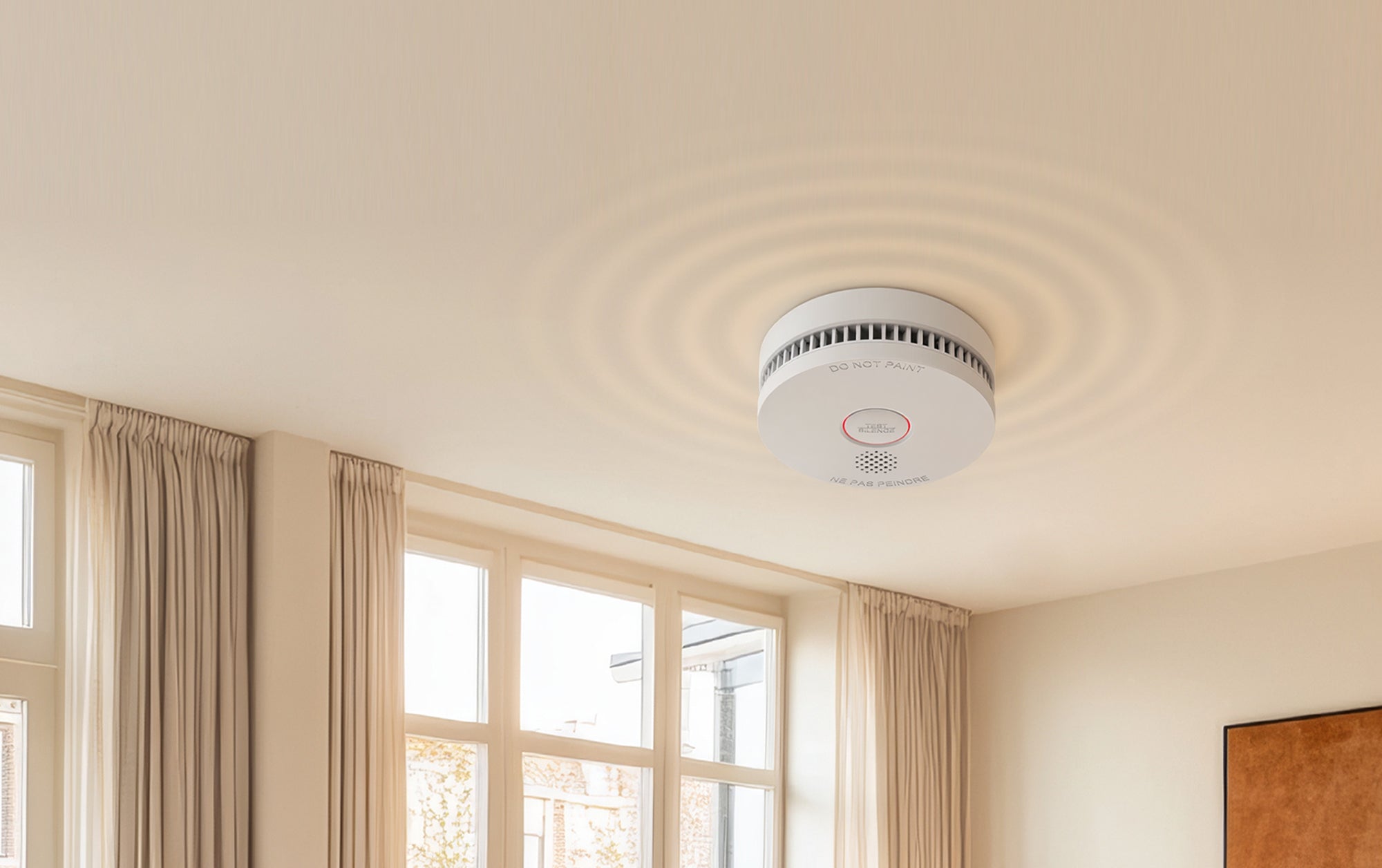
The Device Above Your Head May Already Be Dead
That smoke alarm above your living room doorway — the one you glanced at last spring when it chirped its battery warning, swapped in two AAs, and promptly forgot about — there is a decent chance it is already dead. It just has not told you yet.
According to the National Fire Protection Association (NFPA), roughly three out of every five home fire deaths occur in homes with no working smoke alarm, or where the alarm failed to operate. Dead batteries account for some of those failures. But a lesser-known culprit is age: smoke alarms carry a manufacturer-rated service life of ten years, after which the internal sensing chamber degrades to the point where it may no longer reliably detect smoke. The device keeps sitting on the ceiling. The test button still beeps. The underlying sensor, however, has quietly checked out.
This is not a fringe scenario. Industry surveys consistently find that more than 30 percent of American households are running smoke alarms older than a decade. For a product whose entire job is to wake a family before a fire kills them, "old and unreliable" is a failure mode that deserves more attention than it gets.
Why Smoke Alarms Age Out Faster Than Most People Expect
Every smoke alarm — whether ionization, photoelectric, or dual-technology — contains a sensing chamber that must remain clean and chemically stable to function. Over time, even in a sealed housing, the internal components are subject to measurable decay:
- Dust accumulation inside the sensing chamber. No home is truly particle-free. Airborne cooking grease, household dust, and microscopic debris gradually coat the sensor elements and shift detection thresholds.
- Oxidation of electrical contacts. The microscopic connections that carry detection signals corrode at a slow but steady rate, introducing resistance and signal noise.
- Radioactive source decay (ionization alarms only). These alarms use a small Americium-241 source; while not a health hazard in any practical sense, its sensing effectiveness diminishes across the product's rated lifespan.
- Capacitor and circuit board degradation. The electronics governing alarm logic age just like any other consumer electronics — capacitors leak, solder joints loosen, logic circuits drift.
The practical consequence is an alarm that once reliably detected smoke concentrations well below the UL 217 activation threshold may eventually require concentrations many times higher before it triggers. In a real structure fire, those extra seconds — or minutes — are precisely the margin that separates a family reaching the exit from one that does not.
How to Find Your Alarm's Manufacture Date Right Now
The manufacture date is printed on a label on the back of every smoke alarm. Pull the unit off the ceiling, flip it over, and look for a "Date of Manufacture" or "Manufactured" stamp — usually formatted MM/YYYY or similar.
Here is how to read what you find:
- Within the last nine years: The alarm is still within its rated service life. Test it monthly and move on.
- Between nine and ten years old: The replacement window is open. Budget for new units now rather than in six months.
- More than ten years old: Replace it today — not this weekend, not when the next battery chirp happens. Today.
- No label at all: This is its own red flag. Early-generation alarms sometimes shipped without printed manufacture dates. If the homeowner cannot recall when the device was installed, the safe assumption is that it is overdue.
A proper home audit takes roughly ten minutes. Pull every alarm off every ceiling and wall. Date-check them all. Many households discover, on doing this exercise for the first time, that the alarm protecting a guest bedroom or finished basement has been there since the previous owner's tenure.
The 10-Year Sealed Battery Alarm Changes the Math
When replacing expired units, homeowners have a meaningful option that did not always exist: the 10-year sealed battery smoke alarm. These devices contain a non-replaceable lithium power cell engineered to match the full decade-long service life of the alarm itself. No battery drawer. No 2 AM chirping battery-low warning. No "I'll replace that battery next weekend" moment that quietly never comes.
The practical benefit is significant. The U.S. Consumer Product Safety Commission (CPSC) has found that battery issues — missing, disconnected, or dead batteries — are among the most common reasons smoke alarms fail to operate in residential fires. A sealed-battery design eliminates that failure mode by design rather than by relying on homeowner discipline. For rental properties, vacation homes, or any dwelling where regular battery maintenance is easy to forget, this distinction is not trivial.
Several states have already moved this from a best practice to a legal requirement. California, Massachusetts, and an expanding list of jurisdictions now mandate 10-year sealed battery smoke alarms in new construction and alarm replacements, citing a direct relationship between battery-related failures and preventable fire deaths. Building codes across the country tend to follow California's lead within a few years, so this shift is accelerating.
Interconnected Smoke Alarms: The Upgrade That Matters Most in Multi-Story Homes
Replacing a single expired alarm is a start. Replacing every alarm in the house with a connected system is the upgrade that actually protects a family during a nighttime fire on another floor.
Interconnected smoke alarms — either hardwired to a shared circuit or wirelessly linked — trigger every alarm in the network the moment any single unit detects smoke. If a fire starts in the basement at 3 AM, a hardwired or wirelessly interconnected smoke detector system ensures the alarm sounds in the second-floor bedrooms where the family is sleeping, not just in the room where smoke is present. NFPA 72 strongly recommends interconnected alarms for all residential occupancies for precisely this reason.
For existing homes without hardwired alarm circuits, modern wireless interconnected smoke alarms can link a whole-home system without running a single new wire. The installation is no more complex than installing a standard battery-operated smoke alarm, and the coverage improvement is dramatic.
Combination Smoke and CO Alarms: One Replacement, Two Threats Covered
The expiration-driven replacement moment is also the most efficient time to upgrade to a combination smoke and CO alarm. Carbon monoxide is produced by any fuel-burning appliance — gas furnaces, water heaters, ranges, fireplaces, and attached-garage vehicles — and it kills without any visible or olfactory warning. The CPSC estimates that unintentional non-fire CO poisoning causes approximately 400 deaths annually in the United States, with thousands more emergency-department visits.
A combination smoke and CO alarm collapses two critical safety systems into one ceiling-mounted device, reducing the number of units to maintain and simplifying the ten-year replacement tracking. For renters, apartment dwellers, or homeowners upgrading a full home system at once, the math on a combination alarm is straightforward: fewer devices, fewer batteries (or one sealed cell covering both functions), and the same square footage of ceiling coverage doing twice the protective work.
The 10-Minute Alarm Audit Checklist
No contractor, no permit, and no special tools are required. Here is the complete home audit sequence:
- Remove every smoke alarm and carbon monoxide alarm from its mount.
- Locate and read the manufacture date label on the back of each unit.
- Set aside any unit 10 years old or older for immediate replacement.
- Test every unit still within its service life using the test button; a failed or faint response means replacement regardless of age.
- Verify placement: at minimum, one alarm on each level of the home, one inside every bedroom, and one outside each sleeping area.
- If replacing units in a wired interconnected system, confirm replacement models are compatible with the existing circuit or wireless network protocol.
- Record new purchase dates somewhere durable — a photo of the receipt in a cloud folder, a phone calendar reminder set for nine years out, or a note taped inside the electrical panel door.
The NFPA recommends testing smoke alarms monthly and replacing them on a strict ten-year cycle. Pairing that replacement with a 10-year sealed battery alarm eliminates the battery variable entirely, leaving only age as the clock to monitor.
The Number That Should End Any Debate About Waiting
The NFPA's analysis of residential fire fatality data shows that when smoke alarms were present and operating, the home fire death rate was more than 50 percent lower than in fires where no alarm operated. That statistic is not about whether a household owned a smoke alarm. It is about whether the alarm worked when it was needed.
Ten years. That limit is stamped on the back of every smoke detector ever manufactured and has been the industry standard for decades. The only remaining question is whether the families living beneath those devices know that the clock — for a startling number of American homes — ran out quietly, a long time ago.