The Statistics Every Cook Should Read Once
Cooking is the number one cause of U.S. home fires, accounting for nearly half of all reported home structure fires according to the National Fire Protection Association. That grease fire flaring up on a summer Saturday—whether it's a cast-iron skillet gone wrong or a stovetop left unattended for three minutes—is the most statistically likely fire any American household will ever face. And the bitter irony? The smoke alarm meant to catch it may be mounted in exactly the wrong position to respond in time, or—equally problematic—may be triggering so many nuisance alarms during normal weeknight dinners that the family has quietly disabled it. Both outcomes end the same way.
This is a preventable problem, and it starts with understanding why kitchens demand different thinking from the rest of the home when it comes to fire safety.
Why the Kitchen Breaks Every Normal Smoke Alarm Rule
The average residential smoke detector is engineered to sit quietly, cost little, and respond to particles of combustion. What it is not engineered for is the daily physics experiment that is the American kitchen. Grilling, sautéing, toasting, and broiling all release aerosols, heat plumes, and trace smoke particles that look identical to the early stages of a real fire to a sensor that cannot tell a burning chicken wing from a burning house.
The NFPA's own data reinforces the scale of the problem: cooking equipment is involved in 49 percent of reported U.S. home fires, with unattended cooking as the leading specific cause. A substantial share of cooking-fire fatalities occur not in wildly unsafe kitchens but in perfectly ordinary homes where the smoke detector either was not present in the right location, was disabled after too many nuisance alarms, or simply was not the right type for the environment.
Ionization vs. Photoelectric — The Technology Actually Matters in a Kitchen
Most households inherit whatever smoke detectors came with the house or the rental unit, giving little thought to what's inside the plastic disc. There are two primary sensing technologies, and they behave very differently near a stove.
Ionization alarms use a tiny amount of radioactive material to ionize air inside a sensing chamber. When smoke particles disrupt the ion current, the alarm sounds. Ionization detectors are effective at catching fast-flaming fires—the kind that spread quickly and brightly. The drawback in a kitchen context is that they are also highly sensitive to the combustion aerosols released by everyday cooking, making nuisance alarms a near-daily event for households that cook anything with a smoke point.
Photoelectric smoke detectors use a light beam and sensor; when smoke particles scatter the beam, the alarm triggers. Photoelectric technology is better suited to detecting slow, smoldering fires—which account for a meaningful share of overnight fire deaths—and produces fewer nuisance alarms from cooking aerosols. For a kitchen or an adjacent hallway, a photoelectric or dual-sensor model is the data-supported choice. Installing only an ionization alarm within fifteen feet of a stove is essentially engineering the button-disabling cycle that quietly ends fire protection for an entire household.
The Ten-Foot Rule (And Why Most Homeowners Are Violating It)
NFPA 72, the national fire alarm and signaling code, is direct on kitchen placement: smoke alarms should not be installed within ten feet of a cooking appliance because of the nuisance alarm risk. That sounds like common knowledge. It is not practiced as common knowledge. Field surveys consistently find alarms mounted directly over kitchen islands, on ceilings above ranges, or close enough to the oven that a Tuesday-night pasta dinner triggers a false alarm and someone jams a dish towel under the disc.
The practical interpretation: install the smoke detector in the hallway or adjacent room that connects the kitchen to the rest of the house. This placement keeps the sensor close enough to detect a real fire early while remaining far enough from the cooking zone to filter out routine cooking particles. In open-plan layouts—increasingly standard in American homes built since 2000—this may mean mounting the alarm on the far side of the kitchen at the boundary with the living area, where airflow carries smoke but cooking aerosols have dispersed.
Gas Stoves and the Case for a Combination Smoke and CO Alarm
Roughly 40 percent of U.S. homes use natural gas for cooking, which introduces a risk that sits entirely below the detection threshold of a standard smoke detector: carbon monoxide. Gas ranges, particularly older models or those with improperly maintained burners, can emit measurable CO during normal use. In poorly ventilated kitchens—a description that fits a surprising number of American apartment kitchens—CO can accumulate to levels that impair judgment before any occupant realizes something is wrong.
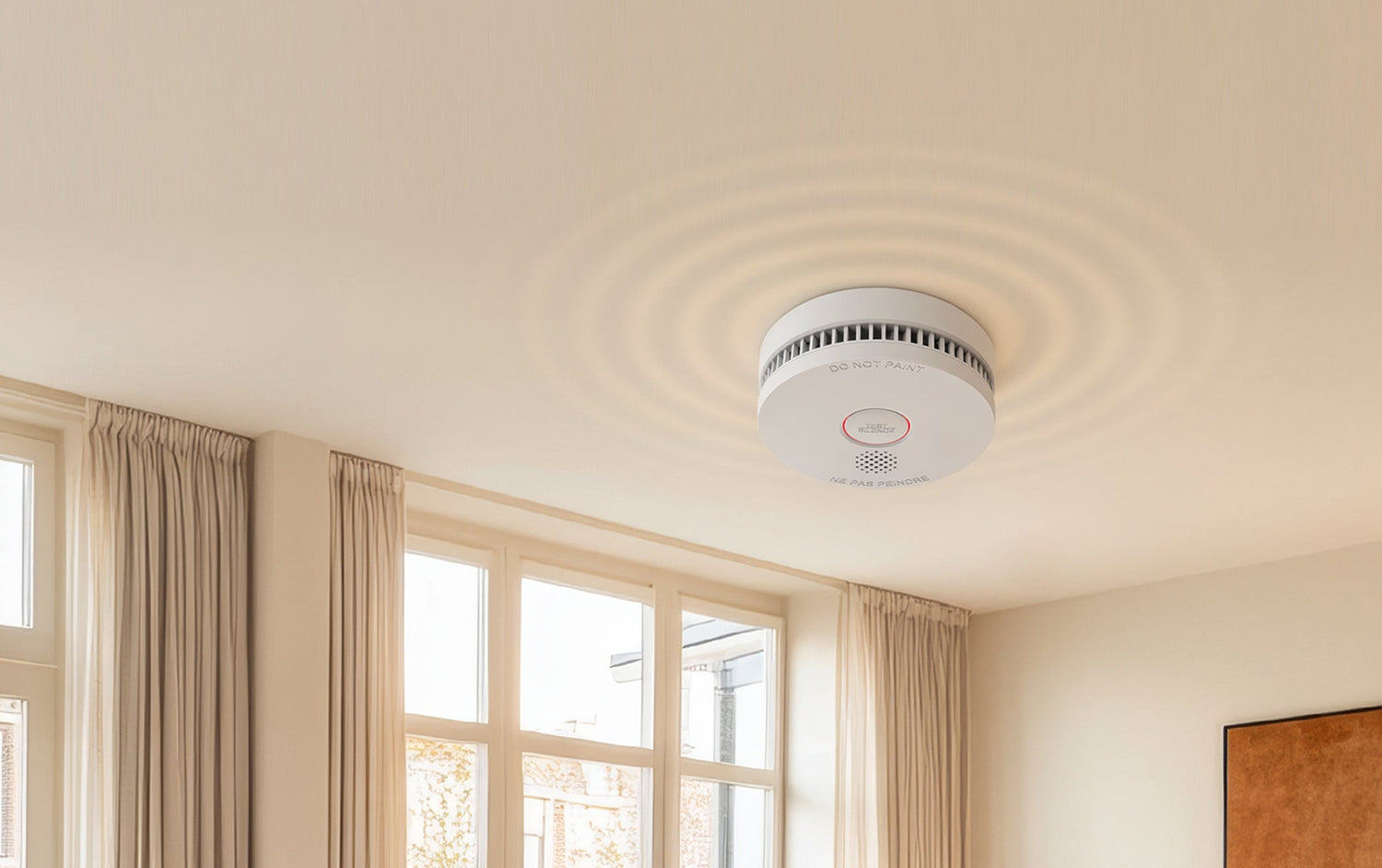
A combination smoke and CO alarm addresses this with a single device. Rather than running separate sensor types on separate replacement schedules, households with gas appliances can install one combination alarm that monitors for both fire and CO simultaneously. For households with elderly members or young children who sleep while cooking finishes in a slow cooker or oven, this overlap in protection is not redundant—it is a practical risk reduction with a single installation footprint.
The carbon monoxide alarm requirement is no longer optional in most of the country. More than forty U.S. states mandate CO detectors in residential settings. A combination unit satisfies both requirements while cutting the total number of ceiling-mounted devices and the associated maintenance overhead.
Interconnected Smoke Alarms and Why the Kitchen Alarm Cannot Work Alone
Here is the gap that catches households off guard: the smoke alarm in the kitchen hallway triggers, but the person asleep in the second-floor bedroom does not hear it. Homes with more than one story, homes with insulated interior walls, and homes where bedroom doors are closed at night all share this failure mode. A single alarm that only a sleeping occupant cannot hear is not meaningfully different from no alarm.
Interconnected smoke alarms solve this. When any single alarm in the network triggers, all alarms sound simultaneously. The NFPA explicitly recommends interconnected smoke alarms for all dwelling units and requires them in new residential construction across most jurisdictions. A hardwired smoke detector network connected to the home's electrical system with battery backup represents the gold standard: the interconnect runs through the house wiring, and battery backup keeps the system functional during a power outage—which is, statistically, when fire risk from candles and alternative heating sources peaks.
For existing homes where rewiring is not practical, wireless interconnected smoke alarms using radio frequency communication achieve the same whole-home alert without structural renovation. A battery-operated smoke alarm with wireless interconnect capability gives renters and homeowners alike a path to whole-home coverage without scheduling an electrician. The key requirement is consistency: all units in the network must be from the same interconnect protocol family to guarantee communication.
The 10-Year Sealed Battery Alarm Changes the Maintenance Math
Battery replacement is where most smoke alarm protection quietly fails at scale. A homeowner who installs fresh batteries in nine alarms across a three-story home manages a reasonable cycle in year one. Two years later, the batteries are mixed-vintage; some are dead, some were swapped at 2 AM when an alarm beeped and a generic AA battery was grabbed from the junk drawer. The result is a household that sincerely believes it has functional smoke detection but is operating with significant protection gaps.
A 10-year sealed battery alarm eliminates this equation entirely. The sealed lithium cell is engineered to power the sensor for the full ten-year rated life of the alarm—which is also, by design, the end of the unit's recommended service life. At the ten-year mark, the entire alarm is replaced: sensor and battery together. California, Oregon, Washington, and a growing list of states now mandate 10-year sealed battery alarms in new construction and residential real estate transactions. The CPSC has noted that the most commonly cited reason for non-functional smoke alarms in fire fatalities continues to be dead or missing batteries, which the sealed design architecturally removes from the failure tree.
For a kitchen-adjacent smoke detector that experiences above-average humidity and temperature cycling, the sealed battery design also reduces the corrosion risk that can quietly compromise standard battery terminals over years of service without triggering any visual indicator.
A Practical Kitchen Smoke Alarm Checklist
The science and statistics point toward a clear set of actions for any household that cooks more than twice a week:
- Confirm no smoke detector is mounted within ten feet of the cooking appliance.
- Replace any ionization-only alarm near the kitchen with a photoelectric or dual-sensor model to reduce nuisance alarm frequency.
- Install a combination smoke and CO alarm in any kitchen or hallway served by gas appliances.
- Verify that all smoke alarms in the home are interconnected—either through hardwired interconnect or wireless pairing—so a kitchen-zone alarm wakes the whole house.
- Check the manufacture date printed inside each alarm unit. Alarms older than ten years must be replaced regardless of apparent functionality.
- Where replacing a battery-operated smoke alarm near the kitchen, choose a 10-year sealed battery alarm to remove the battery-gap failure mode from the equation.
- Test every alarm in the network monthly by pressing the test button for a full three-second hold.
The Alarm That Cried Wolf Is a Safety Emergency
A nuisance alarm disabled with a strip of electrical tape over its sensor is not a smoke detector—it is a plastic disc attached to the ceiling. NFPA data consistently indicates that roughly three in ten U.S. home fire deaths occur in homes with smoke alarms present that failed to operate. The most commonly documented reasons are missing, dead, or disconnected batteries. A kitchen smoke detector that triggers during every dinner sets up exactly this failure mode: the family disables it, the calendar moves forward, and the smoke detector nobody ever re-enables is the one that was supposed to catch the grease fire on the July Fourth weekend.
If an alarm is generating repeated false alarms, the answer is not to disable it. The answer is to evaluate placement against the ten-foot rule, replace an ionization-only unit with a photoelectric model, or relocate the sensor. Modern interconnected smoke alarms from quality manufacturers incorporate processing logic to distinguish short cooking-aerosol bursts from sustained smoke events, materially reducing false positive rates without compromising real-fire sensitivity.
Every Year the Numbers Hold. The Variables Are the Choices Made Now.
The NFPA data on cooking fires has remained remarkably stable for over a decade. The proportion of U.S. home fires attributable to cooking, the role of unattended appliances, the overrepresentation of kitchen events in overall residential fire statistics—these figures persist because the root behaviors persist. What changes year to year is whether individual households have the right fire safety hardware in the right location, interconnected across the home, with a reliable power source that does not depend on someone remembering to buy batteries before the next holiday weekend.
The corrective steps are straightforward. The technology is affordable. A combination smoke and CO alarm with interconnect capability and a 10-year sealed battery costs less than most households spend on a single dinner out. The gap between a home that is genuinely protected and one that merely looks protected comes down to a handful of deliberate decisions—starting with measuring the distance between that ceiling disc and the nearest burner.