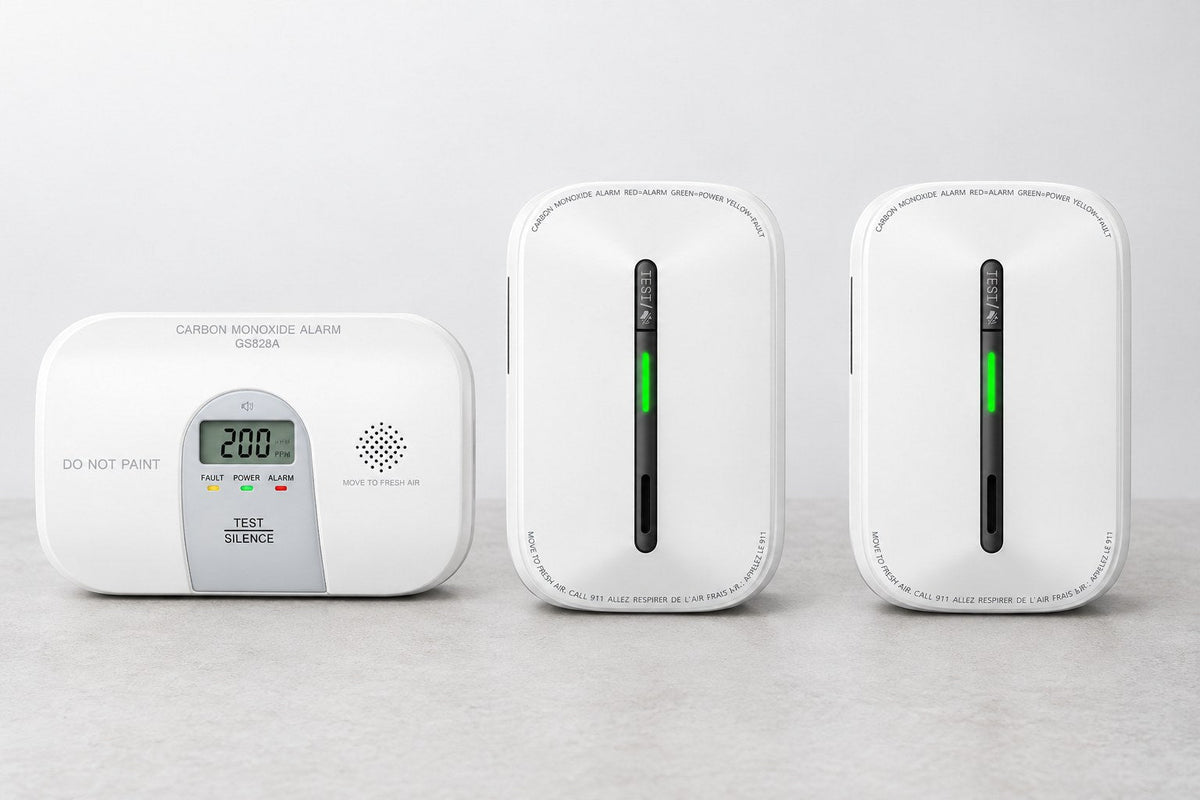
Carbon monoxide does not rise to the ceiling or fall to the floor as a separate layer. It is only about 3% lighter than air — a relative density of 0.97 — and that is far too little for the gas to stratify against the air movement in a home. No single mounting height suits every alarm; the instructions that ship with your model are the only reliable source.
That answer surprises people, because two opposite beliefs circulate at once: that CO is heavier than air and settles low, and that it is lighter than air and collects high. Both are wrong, and they are wrong for the same reason.
Is Carbon Monoxide Heavier Than Air?
What the numbers say
No. Carbon monoxide is not heavier than air; it is very slightly lighter. The CDC's NIOSH Pocket Guide to Chemical Hazards lists it at a molecular weight of 28.0 and a relative gas density of 0.97, with air set at 1.00. Air is itself a mixture that averages about 29, so CO comes out roughly 3% lighter than the air around it.
Carbon dioxide is a different gas with a different number: about 44 g/mol, roughly 1.5 times the density of air. That difference is large enough to matter, and it is one reason the two gases get confused.
Why density alone does not predict where CO goes
Relative density describes how a gas compares with air. It does not say where the gas will end up. The NIOSH figures put CO within about 3% of air, and everything that moves air in a house — fans, open doors, footsteps, heating and cooling — is far stronger than a 3% density difference. That is why a leak spreads through the space instead of settling into a band at one height.
None of this means the concentration is identical everywhere. It means the differences come from airflow, distance to the source and what is between rooms, not from the gas preferring a particular height.
Does Carbon Monoxide Rise or Fall in a House?
In practice, CO does both at different moments, and neither is caused by the density of the gas itself.
Warm exhaust really does rise
Combustion gases leave a furnace, water heater or generator hot, and hot gas rises. That is where the "CO goes up" idea comes from, and it is real. But the lift comes from heat, not from the CO molecule, and it fades as the exhaust cools and mixes with room air.
Airflow, doors and floors decide where it goes
Once mixed, CO travels with the air: through doorways, stairwells and ductwork, pushed by pressure differences inside the building. A closed door, a separate floor or a strong draft can change how quickly a given alarm sees a leak. A source in a basement and a blocked flue on a second floor do not behave the same way, and neither is well described as simply rising or sinking.
That matters more for coverage than for height, and it is one reason the guidance quoted below insists on an alarm on every level.
What This Means for Alarm Placement
Strip out the chemistry and the rules are about coverage, airflow and access to the sensor.
- Near sleeping areas. Both Siterwell standalone manuals call for a bedroom or hallway close to the sleeping area, audible from every sleeping room. The GS828A manual adds that if you install only one alarm, it should not go in the basement or furnace room.
- On every level, including the basement.
- Away from fuel-burning appliances. Both standalone manuals specify at least 5 feet, and recommend 15 feet to prevent nuisance alarms.
- Out of dead air and drafts. Vaulted ceiling peaks, gable ends, the turbulent air under a ceiling fan, fresh-air vents, and the space beside doors and windows that open outside.
- Where the sensor stays clean and reachable. Not behind curtains or furniture, not in steamy or greasy rooms, and within reach for testing.
Beyond those rules there is no universal number. If you want the room-by-room version, our guide to where to place a carbon monoxide detector covers bedrooms, basements, garages and more.
Why Different CO Alarms Have Different Height Rules
Alarms are designed and mounted differently, so the instructions have to differ too. The clearest demonstration is to read our own manuals side by side.
GS828A: a six-foot floor clearance
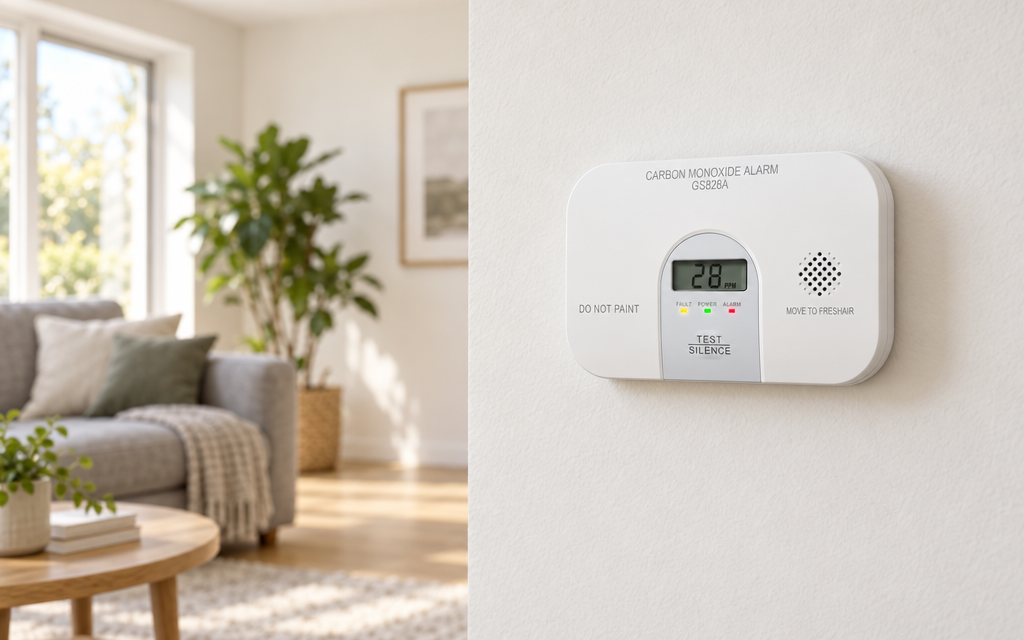
The GS828A is a wall-mounted model, and its manual is specific about height: "The recommended position for the unit should be at least 1.8 meters (about 6 feet) above the floor level." The same manual also says: "Placing at eye level allows for optimum monitoring of the red and green indicator lights." The display shows the current reading in parts per million (ppm) alongside those lights, which is part of why the manual wants the unit somewhere you can actually see it.
Those two quoted lines do different jobs. The eye-level note is about being able to see the indicator lights. The six-foot figure is the manual's recommended mounting position — the word it uses is "recommended" — and it applies to this model regardless of how the gas behaves.

GS846A: no height number, but a fixed mounting type
The GS846A is a plug-in model that goes into a standard non-switched 120V wall outlet, and its manual gives no numeric mounting height. Its only height-related instruction is the same eye-level note about the indicator lights. Separately, it requires at least 5 feet from heating or cooking appliances and recommends 15 feet to reduce nuisance alarms.
"No number" is not the same as "any position". With a plug-in alarm the outlet decides the height, and the outlet still has to sit somewhere that meets the other placement rules. It also means the alarm can only go where there is a suitable outlet, which is a real constraint in older homes.
Combination alarms: what the extra ceiling rule is for
Siterwell's combination smoke and CO alarms — the five GS886 combination models — add a rule the standalone CO alarms do not have: when wall-mounted, the top edge sits between 4 and 12 inches (10 to 30.5 cm) below the ceiling. They also ask for at least 6 feet (1.8 m) above the floor, the same floor clearance the GS828A manual recommends. Both rules appear in all five manuals we reviewed. Those manuals list the product standards as UL 217 and UL 2034 — one for the smoke sensor, one for the carbon monoxide sensor.
The manuals explain the reason, and it is smoke, not CO: "Smoke, heat, and combustion products rise to the ceiling and spread horizontally." Smoke really does rise, so a smoke sensor needs to sit near the ceiling. Those numbers serve the smoke sensor. They are not evidence that carbon monoxide collects high.

The table below compares what the manuals actually say. It shows why the instructions differ between products. It is not a universal installation rule, and a figure from one model does not transfer to another — check the manual supplied with your exact alarm.
| Model | Type | What the manual says about height | Other placement limits |
|---|---|---|---|
| GS828A | Wall-mounted standalone CO alarm | At least 6 ft (1.8 m) above floor; described as the "recommended position" | Wall-mounted; at least 5 ft from heating and cooking appliances (15 ft recommended) |
| GS846A | Plug-in standalone CO alarm | No numeric height; height follows the 120V outlet | Fits a standard non-switched 120V outlet; 5 ft minimum from appliances (15 ft recommended) |
| GS886 family (five models) | Combination smoke and CO alarm | At least 6 ft (1.8 m); wall-mounted top edge 4 to 12 in below ceiling (all five manuals) | Ceiling-mounted units at least 4 in from the side wall |
Carbon Monoxide vs Carbon Dioxide: Why the Two Get Confused
CO and CO₂ are different gases with similar names, and both come from burning fuel. That is where confusion can start, and it usually travels in one direction: people apply carbon dioxide's behavior to carbon monoxide.
CO₂ is genuinely denser than air, and it does collect in low-lying spaces. The classic examples are fermentation rooms, pits and cellars, and sealed rooms where dry ice is stored. A CO₂ safety poster, or a memory of a CO₂ fire extinguisher, describes real behavior that simply does not transfer to carbon monoxide.
Where the carbon monoxide in a home actually comes from is a separate question. Our breakdown of what triggers carbon monoxide alarms covers furnaces, water heaters, generators and attached garages.
| Gas or mixture | Molecular weight (g/mol) | Relative density (air = 1.00) | Behavior in a room |
|---|---|---|---|
| Carbon monoxide (CO) | 28.0 | 0.97 | Mixes with room air rather than forming a stable layer |
| Room air | About 29 | 1.00 | Moves with HVAC, fans, doors and foot traffic |
| Carbon dioxide (CO₂) | About 44 | About 1.5 | Dense enough to accumulate in low or enclosed spaces |
What UL Standards & Engagement Says
UL Standards & Engagement publishes UL 2034, the standard for household carbon monoxide alarms, and its consumer myth-busting page addresses this question directly:
"Myth #1: Carbon monoxide is heavier than air, so alarms should go near the floor. This is false. CO has roughly the same density as air and disperses throughout a room. As a result, there is no single 'correct' height for alarm placement. The manufacturer's installation instructions are the only reliable source for information on where to place a detector. But one thing is clear across all situations: every home needs a CO alarm on every level."
One distinction is worth keeping straight. That paragraph is ULSE's consumer guidance about the standard, not the text of UL 2034 itself. The standard tells manufacturers what an alarm has to do; the guidance tells households how to use one. They are not the same document.
What the EPA Page Says — and What It Does Not
The U.S. Environmental Protection Agency's page on where to place a carbon monoxide detector answers the question with the manufacturer's booklet: "Follow the installation instructions found in the manufacturer's use and care booklet that accompanies the product... It's important to follow these instructions exactly." It also states that each floor of the home needs a separate detector.
The page has not always read that way. An archived version from 2020 and 2021 opened with a specific height: "Because carbon monoxide is slightly lighter than air and also because it may be found with warm, rising air, detectors should be placed on a wall about 5 feet above the floor. The detector may be placed on the ceiling." That paragraph is gone. The versions archived since at least January 2023, and the page today, carry the manufacturer-instruction wording instead.
So the five-foot figure you still see quoted is real history, not current guidance. It is also roughly eye level, which is a common recommendation in manuals.
What to Do If Your CO Alarm Sounds
ULSE's research found that only 42% of people who had experienced a CO alarm actually evacuated. Others opened windows, disabled the alarm, or waited to see whether it would stop.
If an alarm sounds outside an intentional test: get everyone out, including pets; call 911 from outside; do not re-enter until first responders confirm it is safe. Do not spend time looking for the source or opening windows first, and do not wait for symptoms before leaving.
Not every sound is an emergency. A single chirp at a fixed interval — 40 seconds on the GS828A — usually means a low battery or a fault rather than CO. Patterns differ by model, so match what you hear against your own manual; if you cannot, treat it as an alarm and leave. Our guide to why carbon monoxide detectors beep walks through the common patterns, and our step-by-step guide to testing a carbon monoxide detector covers what the test button does and what to expect.
Frequently Asked Questions
Is carbon monoxide heavier or lighter than air?
Slightly lighter. The NIOSH Pocket Guide gives CO a molecular weight of 28.0 and a relative gas density of 0.97, where air is 1.00 — about 3% lighter. That gap is far too small to hold a separate layer against the air movement in a normal room.
Does carbon monoxide rise to the ceiling?
Not as a layer of gas. Warm exhaust can carry CO upward while it is hot, and room air carries it everywhere else. What does not happen is CO separating out and sitting at the ceiling because it is lighter than air.
Where does carbon monoxide settle?
It does not settle into a low layer. That behavior belongs to carbon dioxide, which is about 1.5 times as dense as air. Advice to "put the detector near the floor because CO is heavy" describes carbon dioxide, not carbon monoxide.
Should a CO detector be high or low?
That depends on the model, not on the gas. The Siterwell GS828A is wall-mounted and its manual recommends at least 6 feet (1.8 m) above floor level; the GS846A plugs into a 120V outlet and gives no numeric height. Follow the manual for your specific unit rather than a general rule about height.
What height should a carbon monoxide detector be placed?
There is no universal number. ULSE states there is "no single 'correct' height for alarm placement" and points to the manufacturer's instructions. In practice that means model-specific figures, such as the 6 feet the GS828A manual recommends, and outlet height for the GS846A.
Can carbon monoxide travel between floors?
Yes. CO moves with air through stairwells, doorways and ductwork. Closed doors and separate floors can slow it down enough that a single alarm never sees the leak in time, which is why every level needs its own alarm.
Will opening a window stop carbon monoxide?
No. A window dilutes CO with fresh air, which may lower a reading, but it does not stop the source and does not make the building safe. If an alarm is sounding, leave and call 911 from outside rather than ventilating first.
Why do combination alarms have different mounting rules?
Because they also contain a smoke sensor. Smoke and heat rise to the ceiling, so those units sit near it — 4 to 12 inches below the ceiling when wall-mounted, and at least 6 feet above the floor. Those numbers come from the smoke side of the device, not from how CO behaves.
Sources
- UL Standards & Engagement — "5 Carbon Monoxide Myths That Could Put Your Family at Risk", by Diane Haithcock, Director of Standards Programs, September 14, 2026.
- CDC / NIOSH Pocket Guide to Chemical Hazards — Carbon Monoxide.
- U.S. Environmental Protection Agency — "Where should I place a carbon monoxide detector?"; the 2020 wording quoted above is from the Internet Archive capture of 13 June 2020, and the replacement wording was already in place in the capture of 2 January 2023.
- Siterwell product manuals, specifically the GS828A manual (section 1.1, installation location; section 1.2, mounting type) and the GS846A manual (recommended location for alarms, items 2-6).
- Siterwell GS886 combination manuals (GS886-H02, GS886A-3NCDT, GS886A-3RFDT, GS886A-3WCAR, GS886F-H02) — installation instructions, items 7-10, covering the 6-foot clearance and the 4-to-12-inch wall rule.
About this guide
This guide was written by the Siterwell product team. Siterwell designs and manufactures the carbon monoxide alarms described here, and the manuals below are our own.
Manuals reviewed: GS828A (installation location, section 1.1; mounting type, section 1.2), GS846A (recommended location for alarms, items 2–6) and the five GS886 combination manuals (installation instructions, items 7–10). The wording was checked against the current text of each manual on October 20, 2026.
How it was checked: the installation sections were compared for mounting type, height guidance and placement restrictions. Where a manual gives a number, the number is quoted rather than summarized; where it gives none, the article says so instead of inferring one.
Limitations: these examples do not cover every model or installation condition. Two of the source PDFs (GS846A and GS886-H02) are scanned copies, so their wording was read from OCR. GS886-H04 is sold as a smoke alarm and is not counted among the combination models here. External figures come from the CDC/NIOSH Pocket Guide and ULSE's published guidance, both linked above.
This is general safety information and does not replace the manual supplied with your alarm. Always follow the instructions for your specific model.