Alarm sounding outside an intentional test? That is an emergency — get everyone to fresh air and call 911 now. Do not wait to see whether it sounds again.
Carbon monoxide (CO) is invisible, odorless, and does not irritate your eyes or throat. That is why the only warning most households ever get is an alarm that actually works. Testing a carbon monoxide detector takes about a minute per unit. Below is how to test yours correctly, what the test button really proves, and what it does not.
How to test a carbon monoxide detector in 4 steps:
- Tell everyone in your home you are about to test the alarm. CO alarms are loud by design — typically around 85 decibels — and people in the same room will hear it.
- Press and hold the TEST/SILENCE button until the alarm sounds. On Siterwell's standalone alarms, that is about 2 seconds; on combination models it is just over 1 second. Hold times differ by brand, so follow the hold time printed in your model's manual; if nothing happens after a few seconds, release and check the manual before assuming the unit has failed.
- Listen for four quick beeps, then a pause of roughly five seconds, repeating — and on talking models, the voice message "Warning! Carbon Monoxide." On a combination smoke/CO alarm you will hear the smoke pattern (three long beeps) first, then the CO pattern.
- Act on the result. If the alarm is silent, weak, or distorted when you test it, or the unit is past the end-of-life date printed on its label, replace it rather than troubleshooting further. Replace at the manufacturer's stated end-of-life date — read the date or service-life marking on the unit itself, because a passing button test does not extend sensor life.
Test every CO alarm at least once a month. That is a practical industry baseline rather than a rule of its own. Siterwell's own manuals go further and recommend testing weekly. When general guidance and your manual disagree, follow the manual for your model — which is exactly what the CPSC tells consumers to do: "Consumers should follow the manufacturer's instructions."
Never test a carbon monoxide detector with a candle, match, lighter, cigarette smoke, vehicle exhaust, a gas stove, or any open flame. An open flame can damage the sensor, soot the vents, or start a fire — and smoke-based methods do not reliably trigger a CO sensor at all. Vehicle exhaust and unlit-gas approaches are worse: you are deliberately introducing the hazard you are trying to guard against, into a space you may not be able to clear. Use only the built-in test button, exactly as your manual describes.
If you have seen a video or forum post showing someone "generating carbon monoxide" to test an alarm, the right conclusion is not "here is how to do it safely" — it is that no consumer should be producing CO indoors. A button test tells you the alarm works; a professional bump test with calibrated gas tells you the sensor works. Those are the only two safe options.
What the test button actually checks — and what it does not
This is the part most guides skip, and it is the difference between a test that reassures you and a test that misleads you.
What a button test confirms: that the alarm has power, that its circuit board is running, that the battery or backup battery connection is sound, and that the speaker or horn can produce the alarm sound. On a Siterwell GS886F-H02 combination alarm, holding the button for more than one second makes the unit run the smoke pattern, then the CO pattern with the voice alert — so one press verifies both channels.
What a button test does not confirm: it does not verify that the electrochemical CO sensor can still detect carbon monoxide gas. Sensors degrade with age and exposure to dust, humidity, and temperature swings, and a unit can pass a button test every month for a decade while its sensing element quietly drifts out of spec. A button test is also not a substitute for cleaning the vents, placing the unit correctly, or replacing it at end of life.
The manuals state this plainly: once the TEST/SILENCE button is pressed, the alarm sounds and the red light flashes — this does not indicate that carbon monoxide is present. A test is a check of the alarm, not a reading of your air.
The U.S. Consumer Product Safety Commission puts it the same way in its own consumer guidance: "Using a test button tests whether the circuitry is operating correctly, not the accuracy of the sensor." That is the same distinction this section draws — and it is the reason a monthly button test, on its own, is not proof that your detector still works.
So the button test tells you the alarm is powered and loud. It does not tell you the alarm can still smell what it is supposed to smell. If you need that level of assurance — in a rental property, a daycare, or a home with a fuel-burning appliance — see how to check the CO sensor itself.

How to test each type of carbon monoxide detector
The basic action is similar across models: use the built-in TEST/SILENCE button. What differs is the hold time, the expected sound pattern, and what you check afterward — so follow the instructions for your exact model rather than a generic rule.
Plug-in CO alarms with battery backup
Alarms such as the Siterwell GS846A plug into a 120V outlet and keep a backup battery for outages. Press the test button, confirm the alarm sounds, then check that the power indicator is lit and the backup battery is healthy. If your home has lost power recently, test again once power is restored — power interruptions are a common trigger for erratic alarm behavior.
Battery-powered and travel detectors with a digital display
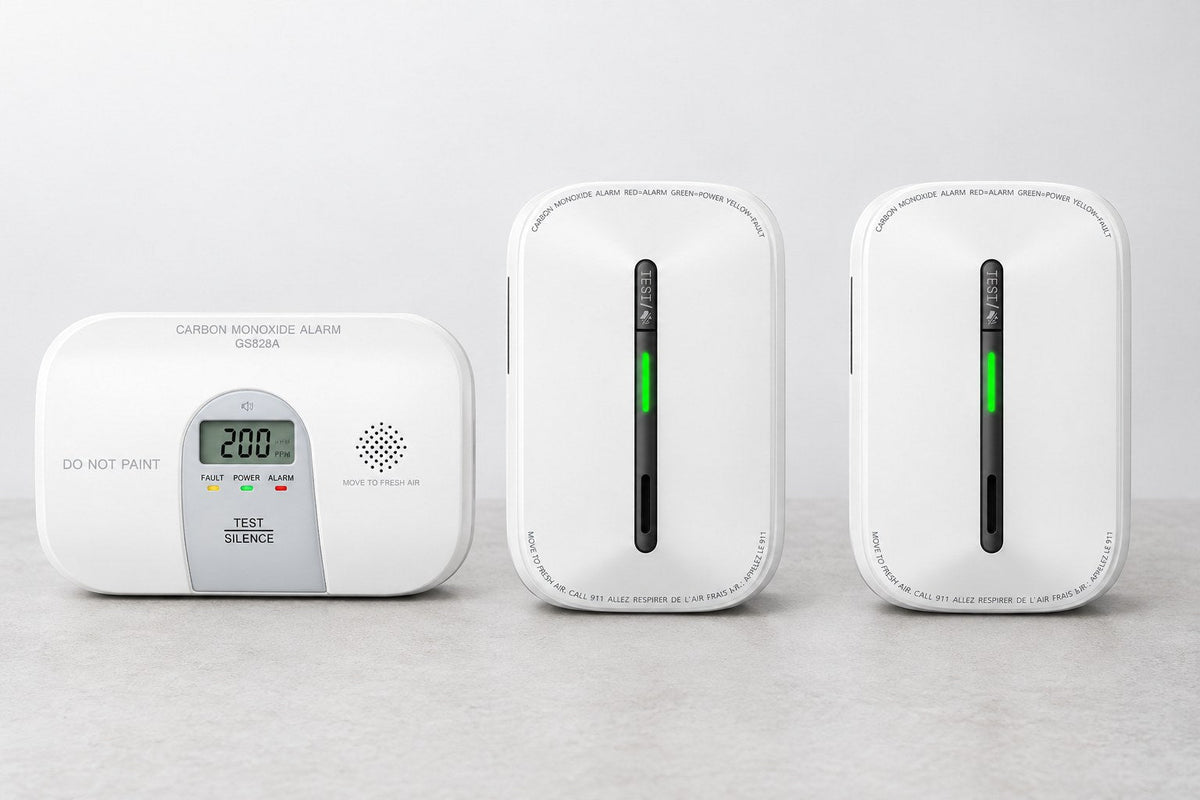
Display models such as the Siterwell GS828A show a live PPM (parts per million) reading. Test with the button, then confirm the display settles at a normal reading — normally 0 PPM in clean air. One caveat: strong airflow from a fan, vent, or open window can push fresh air across the sensor and hold the reading at 0 even when CO is present, so keep the unit out of direct airflow when you check a reading. Display models also keep a peak memory: on the Siterwell GS828A, pressing the button for under one second shows the highest CO concentration recorded since the last reset, then returns to the live reading after about 10 seconds. That peak value is the more useful number to report to a technician, because it records what the air looked like when you were not watching.
One more detail worth knowing: on the GS828A, holding the test button starts the alarm at a reduced volume — under 85 dB for roughly 10 seconds — before ramping up to full output. If your test sounds quiet for the first few seconds, that is deliberate, not a failing speaker.
Hardwired combination smoke and CO alarms
A combination unit such as the Siterwell GS886F-H02 tests both functions with one press. You should hear the three-long-beep smoke pattern, then the four-quick-beep CO pattern, along with the voice alerts. Because combination alarms are loud, stand about 2.5 feet (0.76 m) away or use hearing protection while testing.
Interconnected systems: test every unit, not just one
If your alarms are wirelessly or hardwired interconnected, one press sets off the whole network. That tells you the interconnect signal works — it does not tell you that each individual unit's own CO sensor works. Walk the house and test every alarm separately, including basement and attic units you rarely think about.
What a carbon monoxide detector sounds like — and what each pattern means
Carbon monoxide and smoke alarms use deliberately different patterns, and the difference matters when you are woken at 3 a.m. and have seconds to decide.
| Pattern | What it usually means | What to do |
|---|---|---|
| Four quick beeps, pause of about 5 seconds, repeating — often with the voice "Warning! Carbon Monoxide" | CO alarm: a dangerous carbon monoxide level | Treat as an emergency: get everyone to fresh air and call 911 — see the emergency steps below. Do not wait to see whether it sounds again |
| Three long beeps, pause, repeating — often with the voice "Fire!" | Smoke alarm (on combination units) | Treat it as a fire alarm: get out, then call 911 |
| One short chirp about every 40 seconds, with a yellow fault light | Low battery — not a CO emergency, but the alarm stops protecting you once the battery is drained | Replace the battery straight away |
| Two chirps about every 40 seconds, with a yellow fault light | Fault or malfunction. The unit is telling you it can no longer detect CO | Replace the battery first; if it continues, the alarm has failed — replace the unit |
| Three chirps about every 40 seconds, with a yellow fault light | End of life. The sensor has reached the end of its service life | Replace the alarm |
Read this table with one caveat. The four-beep CO alarm signal (and the three-long-beep smoke signal) is standardised by UL 2034 and is broadly the same across brands. The chirp counts below are model-specific — the one/two/three-chirp meanings here are the ones Siterwell documents, and other manufacturers assign different counts to low battery, fault, and end of life. Confirm against the manual for your alarm before acting on a chirp.
One detail that confuses almost everyone: on many models the green power light also blinks about every 40 seconds. That is a normal heartbeat, not a chirp, and it needs no action. What matters is whether you hear a sound and which light is on beside it — a chirp paired with a yellow or amber light means service or replacement, not a CO emergency.
A CO alarm certified to UL 2034 does not react to a fixed concentration. It reacts to concentration and time, which is why a low-level exposure can take hours to trigger an alarm:
- at or below 30 PPM, the alarm is not required to sound during the first 30 days of continuous exposure
- about 70 PPM within 60–240 minutes
- about 150 PPM within 10–50 minutes
- about 400 PPM within 4–15 minutes
Those figures describe how UL 2034-type residential alarms are designed to respond. They are illustrative, not a substitute for the response behavior stated in your alarm's manual — a CO alarm responds to concentration and time together, not to a single fixed ppm threshold. The Siterwell standalone CO alarms are explicit about the lower limit: the GS828A and GS846A warnings state that the alarm "has not been investigated for carbon monoxide detection below 70 PPM." So neither a low reading nor a silent alarm is a certificate that the air is clean.
That is also why "the alarm did not go off" is not proof that the air is clean. The alarm is doing arithmetic on your behalf. For a fuller breakdown of every beep and chirp, including why units chirp at 3 a.m. and what a chirp after a battery change means, see our guide on why carbon monoxide detectors beep.
How to tell if the CO sensor itself still works
If a button test is not enough assurance — and for some homes it is not — there are three honest options.
1. Understand what the sensor is
Residential CO detectors use an electrochemical sensor: a small cell that generates a tiny current when carbon monoxide reaches it, which the alarm converts into a reading or an alarm decision. These cells are consumable. They dry out and lose sensitivity over time, faster in dusty, humid, or temperature-extreme locations. This is the physical reason every CO alarm has an expiry date — not a marketing one.
Do not confuse the two gases you may have in mind: CO (carbon monoxide) is the combustion hazard these alarms detect. CO₂ (carbon dioxide) is a different gas with a different sensor and a different purpose — a CO alarm will never detect CO₂, and a CO₂ monitor is not a substitute for a CO alarm.
2. Ask for a bump test with calibrated gas
The only method that genuinely verifies sensor response is a bump test using calibrated carbon monoxide gas of a known concentration. Fire departments, HVAC technicians, and some safety-supply companies can perform one. Ask about the fee before booking — and if a technician offers to test with a lighter or a car exhaust, decline.
3. Replace rather than guess
If you do not know the unit's age, the label is unreadable, or the unit has passed its end-of-life date, replacement is the cheapest reliable "test." A new alarm with a fresh electrochemical cell and a printed expiry date is more informative than any diagnostic you can run on a spent sensor.
How often should you test a carbon monoxide detector?
At least once a month, plus any time something might have stressed the unit. A few practices keep the habit from drifting:
- Anchor it to a date. Test on the first of the month, or when you change the clocks for daylight saving — the same trigger that gets people to swap smoke alarm batteries.
- Test after disruptions. Storms, outages, painting, renovations, and moving a unit are all good reasons to retest.
- Keep the vents clean. The intake holes on the sides of a CO alarm are how gas reaches the sensor. Dust, paint, and cleaning sprays block them. Vacuum the vents gently with a soft brush attachment once a month, and never paint the alarm.
- Keep a short record. A dated note in a home maintenance log — or a reminder in your phone — turns a vague intention into a habit you can actually audit.
Frequency and habits overlap heavily with smoke alarm care. Our guide on why regular testing of smoke and CO alarms matters covers the shared routine.
Two warning signs of carbon monoxide in a house
Search results often promise "signs" of carbon monoxide. There are only two that reliably tell you something, and they are not the ones people expect.
1. Your alarm sounds
Because CO has no color, no smell, and no taste, the alarm going off is the warning. There is no earlier stage you can detect with your own senses. Anything you may have read about a "metallic taste," "stale air," or "seeing fumes" is not how CO exposure presents — and treating those as the signal is how people lose the minutes that matter.
2. Symptoms that improve when you leave the building
The second warning sign is what CO does to people: headache, dizziness, nausea, shortness of breath, confusion, or flu-like symptoms without a fever. The distinguishing pattern is that symptoms ease when you go outside and return when you come back in. If several people in the household — or a pet — feel unwell at the same time, treat that as a CO event even if the alarm is silent. Get everyone to fresh air and call 911 or your emergency number.
What is not a warning sign: a smell, a haze, a sooty residue, or the absence of any of those. CO is the hazard precisely because it gives you none of them. For symptoms in the household members most at risk, see our article on carbon monoxide risks for kids and seniors.
If the alarm sounds, or your detector keeps beeping
Two different situations get described with the same word, and they call for opposite responses.
If the four-beep CO alarm sounds outside a test
Leave first. Call from outside. A CO alarm sounding outside an intentional test is an emergency, and the CPSC's own wording is blunt: get out, and do not stop to find the source of the CO. The Siterwell manuals list pressing TEST/SILENCE as the first item in their alarm-response section — that is a control instruction, not a prerequisite. One press on your way out is fine, but never let it delay you, because silencing the alarm does not make the air safe.
- Immediately move everyone outdoors to fresh air. Outside is the goal. The manuals phrase it as "outdoors or by an open door/window" — if you cannot get fully outside, go to that opening and stay at it. Do not stay in the room waiting for the air to clear.
- Call 911 or your local emergency number from outside.
- Do a head count once you are out, including pets if it was safe to bring them.
- Do not re-enter. If you cannot get fully outside, stay at that open door or window. Do not go back in — and do not move away from that opening — until emergency responders have arrived and say it is safe. Whether the building has been aired out and your alarm has returned to normal is their call to make, not yours.
- If anyone has symptoms — headache, dizziness, nausea, shortness of breath, or confusion — tell the dispatcher. Treat it as a medical emergency even if the alarm is no longer sounding.
- Do not rely on silencing, resetting, or a 0 PPM reading to decide whether it is safe to stay inside. Silencing stops the sound; it does not clear the air.
If the alarm reactivates within 24 hours after all of this, repeat these steps and call a qualified appliance technician to investigate CO sources from fuel-burning equipment and check that it is operating correctly.
On the 6-minute rule — read it the right way round. The manuals note that if the unit alarms again within six minutes (five minutes on the combination models), it is sensing high levels of CO. That note tells you a re-alarm confirms a real hazard; it is not an instruction to wait six minutes before evacuating. Never stand in the room timing a re-alarm to decide whether the alarm was "real." Get out, then let the professionals determine the source.
If it is a chirp every 40 seconds — not the four-beep alarm
That is almost never a CO event, but the number of chirps tells you which problem you have: one chirp is low battery, two means the unit has stopped detecting, and three means the sensor has reached end of life (the same three cases as the pattern table above). Silencing any of them without fixing the cause is how homes end up with a dead detector, and on an end-of-life unit the silence lasts only about 9 hours before the warning returns. Our beep and chirp guide walks through each pattern.
How to reset a carbon monoxide detector
There is usually nothing to "reset" in the sense people mean. If the alarm is sounding because it detects CO, resetting it does not remove the CO — it only removes your warning. If the unit is chirping from low battery, replace the battery; if it is at end of life, the correct fix is replacement. Follow your model's manual for silences and resets. And remember that silencing a real CO alarm does not clear the air — if the alarm is sounding outside a test, leaving the building is the only correct response.
If your detector fails the test: a quick decision guide
Most "my detector is broken" situations fall into one of four cases. Match your symptom to the row, and note that in every case where the alarm itself has failed, the correct answer is replacement — not patience.
| What you see or hear | Most likely cause | What to do |
|---|---|---|
| Pressing the button produces no sound at all | Dead battery, no mains power, or a failed unit | Check the outlet and replace the battery (CR123A on the GS846A, AA cells on the GS828A). If it is still silent, replace the alarm |
| The alarm sounds but is weak or distorted | Drained battery, or a failing horn | Replace the battery and retest. A second weak test means the unit is failing — replace it |
| Continuous chirping right after you fit fresh batteries | Battery not seated, wrong battery type, or the unit has reached end of life | Reseat and confirm the battery type. If three chirps continue, the sensor has expired — replace the unit |
| The test works, but the reading never moves from 0 PPM | Normal in clean air — or airflow keeping the sensor artificially clean | Move the unit out of drafts and retest. If you still want proof the sensor works, that requires a bump test with calibrated gas |
If your alarm is more than a few years old and any test disappoints you, treat replacement as the cheap option. A new unit costs less than a service call, arrives with a fresh electrochemical cell, and carries a printed end-of-life date you can put in your calendar.
Should the green light be on? Reading the indicators
Indicator lights vary by model, so read this against your own manual — but the general logic is consistent across residential alarms:
- A steady green power light on a plug-in or hardwired unit means it has AC power and is running. On most models, green on and no sound is the normal state.
- A green light that is off on a hardwired unit usually means mains power has failed; the unit may still be running on backup battery, but that is a condition to check.
- A red LED flashing in step with a test confirms the unit entered test mode and produced its alarm output.
- A yellow or amber fault light, often with a chirp, signals an internal fault or end of life — this is a replace-or-service condition, not a nuisance.
A light being the "right" color tells you the electronics are powered. It still does not tell you the electrochemical sensor is in spec — see how to check the CO sensor itself.
How long do carbon monoxide detectors last?
A CO alarm is not a lifetime device. Most residential units are rated for about 5 to 7 years of sensing life, and some models are documented for longer — Siterwell's combination documentation states a product life of 10 years after manufacture. The number that governs your unit is the one printed on its label, so read the label rather than averaging.
Two practical points:
- End of life is announced. Many units chirp and light a fault indicator when the sensor reaches the end of its life. A temporary silence may be available in the manual, but the alarm still needs replacing — a silenced expired alarm is not protecting anyone.
- After a real CO event, have a qualified technician inspect the source, and follow the manufacturer's guidance on whether the alarm itself should be replaced.
- At the end of the manufacturer's stated service life — read from the label on your unit — replace the alarm regardless of how well it tests. Do not invent a shorter deadline of your own: a unit with a documented 10-year life is not a defective unit at year six.
For the physical and behavioural signs that an alarm is aging out, see our guide on signs your smoke or CO alarm is aging.
Where you place a detector changes what a test tells you
Placement is not part of "testing," but it changes whether your readings mean anything. Keep units away from strong airflow, at least 10 feet from furnaces and stoves and other known CO sources, and out of spaces where the air is deliberately ventilated away. A detector that sits in a draft will report clean air for reasons that have nothing to do with the air in the room. For room-by-room guidance, see our guide to where to place your CO detector.

Carbon monoxide detector testing FAQs
How do I tell if my carbon monoxide detector is working?
Press and hold the TEST/SILENCE button and confirm you hear four quick beeps (on combination units, the smoke pattern first, then the CO pattern). That confirms power, electronics, and the horn. It does not confirm the CO sensor still detects gas — for that you need a bump test with calibrated gas, or a replacement unit.
Can you test a carbon monoxide detector with a candle?
No, and you should not try. An open flame can damage the sensor, soot the vents, or start a fire, and candle smoke does not reliably simulate carbon monoxide. The only approved method is the built-in test button. Testing with a lighter or cigarette smoke carries the same problems and is not recommended by manufacturers.
What do 4 beeps on a carbon monoxide detector mean?
Four quick beeps with a pause of about five seconds, repeating, is the standard CO alarm pattern defined by UL 2034 — it signals a dangerous carbon monoxide level. Get everyone to fresh air and call 911 or your local emergency number immediately; do not wait to see whether it sounds again.
How long should I hold the test button on a CO detector?
Hold until the alarm sounds. On Siterwell's standalone alarms that is about 2 seconds; on combination models, just over 1 second. Brands differ, and the hold time is one of the things that varies most between manufacturers, so use the hold time in your own manual. If the alarm does not sound after a few seconds of holding, release the button and check the manual before assuming the unit has failed.
How often should I test my carbon monoxide detector?
At least once a month is the usual baseline. Many manufacturer manuals, including Siterwell's, recommend testing weekly — follow whichever is stricter for your model, since the CPSC's advice to consumers is to follow the manufacturer's instructions.
Should the green light be on on my carbon monoxide detector?
On most plug-in and hardwired models, a steady green light means the unit has power and is operating normally. If the green light is off on a hardwired alarm, mains power may have failed and the unit may be running on backup battery — check it per your manual. A yellow or amber fault light, usually with a chirp, means a fault or end of life.
How do I get my carbon monoxide detector to stop chirping?
Count the chirps first, because each number means something different. One chirp every 40 seconds is low battery — replace it. Two chirps means a fault, and the unit has stopped detecting; replace the battery, and if the chirping continues, replace the alarm. Three chirps means the sensor has reached end of life and the whole unit must be replaced. Chirping right after a battery change usually means the battery is not seated correctly or is the wrong type. And never silence a four-beep alarm without evacuating — that pattern means carbon monoxide.
Being able to silence a chirp is not the same as fixing it. On most models the silence lasts only around 9 hours, after which the warning returns — and on an end-of-life unit, silencing it repeatedly just leaves an expired detector on your wall.
Why does my carbon monoxide detector show 0 PPM during a test?
A 0 PPM display can be normal in clean air, but it does not prove that no carbon monoxide is present. Display thresholds and test-mode behavior vary by model, and a reading of 0 says nothing about whether the sensor itself is still able to detect gas.
Never use a 0 PPM reading to dismiss an alarm or a symptom. Display thresholds vary by model — some units do not display readings below a floor value, so a "0" can mean "below what this display reports" rather than "none present." And some models show a diagnostic figure during a button test that is not a live gas reading at all. If the alarm is sounding, or people feel unwell, the reading is not the deciding evidence.
What can give a false carbon monoxide reading?
Strong airflow past the sensor can hold a reading artificially low, which is why units should sit away from vents and open windows. Exposure to certain cleaning chemicals, paint fumes, and prolonged humidity can also affect sensors over time. If a unit alarms repeatedly and responders find no CO, ask about replacing the sensor cell or the unit rather than assuming the alarm is faulty.
Can I check carbon monoxide levels with my phone?
No. Phones do not contain carbon monoxide sensors, and apps that claim to measure CO are not measuring gas. A dedicated CO detector or a handheld CO meter is the only way to get a reading.
How long does a carbon monoxide detector last?
Most last about 5 to 7 years of sensing life, and some models are documented for 10 years. The end-of-life date on your unit's label is the number that matters — replace the alarm once it is reached, because a passing button test does not extend sensor life.
Build the habit once, and it takes a minute a month
Testing a carbon monoxide detector is four actions: tell the household, hold the test button, listen for four beeps, and act on what you hear. Add the end-of-life date on the label to your annual review, and remember that the button test proves the alarm is loud — not that the sensor is alive.
Better still, test your CO and smoke alarms on the same day each month, so neither gets forgotten. You can run both routines the same way: see how to test a smoke alarm. If you are setting up a new home, replacing aging units, or adding coverage where you only have smoke detection today, browse our carbon monoxide alarm collection or our combination smoke and CO collection.
Sources and how this guide was prepared: prepared by the Siterwell content team using the Siterwell product manuals for the GS846A, GS828A, and GS886F-H02 (available on our user manuals page), U.S. Consumer Product Safety Commission guidance, and the applicable UL 2034 requirements. This is general safety information and does not replace the manual for your specific alarm — where general guidance and your manual differ, follow the manual that came with your alarm.